
When to Transplant a Tree in Bucks County: Why Fall Is the Window
Every July, someone calls to ask whether we can move a mature tree right away. The honest answer is usually that we can, but that the tree would be far better served by waiting eight weeks. Timing influences whether a transplanted tree establishes successfully more than almost any other factor, and in southeastern Pennsylvania the right timing means autumn.
This article explains why the fall window works, how our local soils change the job, and what the aftercare actually involves once the machine leaves.
The Roots Keep Working After the Leaves Quit
However carefully the work is done, a tree being moved loses a large share of its root system. Everything that follows depends on how quickly it can rebuild those roots, and on how much is being demanded of the tree while it tries. Autumn is generous on both counts, for a few reasons:
- Warm soil, cool air. Root growth continues in warm ground for weeks after the canopy has shut down for the year, so the tree puts nearly all of its energy underground.
- Low demand. There are no new leaves to push and no full canopy to support through summer heat.
- Reliable moisture. Rainfall is typically steadier in autumn than in the middle of summer.
- A long runway. The tree gets fall, winter, and the following spring to establish before it faces its first hot season.
Spring is a legitimate second choice, but the window is short. The work has to fit between the ground thawing and the tree breaking bud, which in this region can amount to only a few weeks, and a wet spring shortens it further because moving heavy equipment across saturated clay damages the rest of the property. Summer is the season to avoid: a tree with a reduced root system in July is being asked to supply a full canopy from a fraction of its plumbing, at precisely the moment demand peaks.
The Window Is Shorter Than People Think
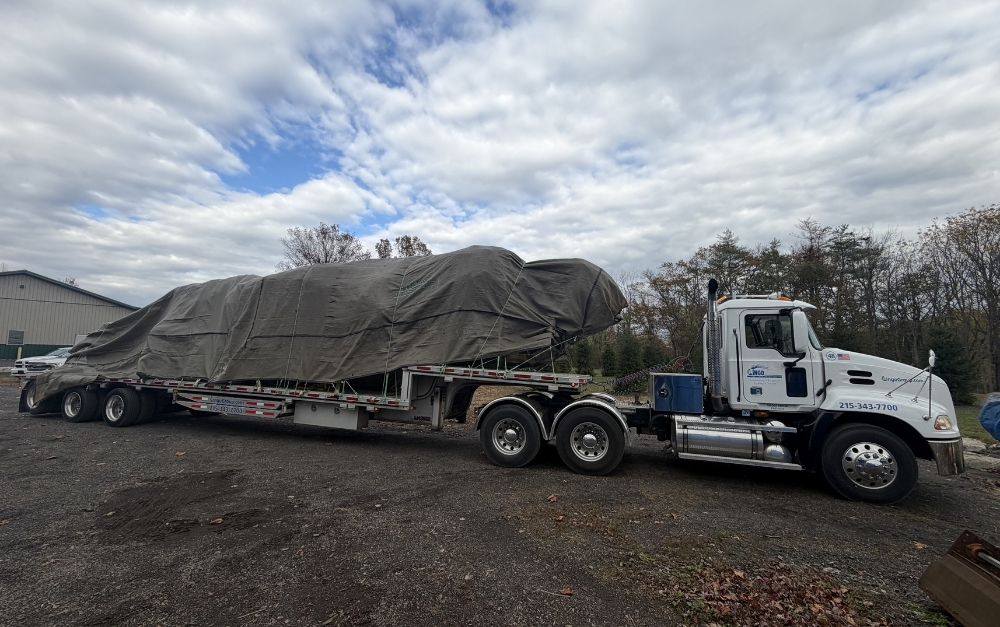
Locally, the useful period opens once the summer heat breaks and night temperatures cool consistently, and it closes when the ground freezes. In practice that means early autumn through late in the year, varying with the season.
The closing date matters more than the opening one. A tree moved two weeks before the ground hardens has very little time to generate new roots before growth stops for the winter. The frost line here runs to roughly three feet, and once the ground is frozen the work cannot be done properly at all. This is why the scheduling call should happen in late summer rather than November; the trees that establish best are booked before the window opens, not squeezed in as it closes.
Some Trees Travel, Some Sulk
Trees vary considerably in how they tolerate relocation. Maples, lindens, hornbeams, most spruces, and many ornamental flowering trees are generally forgiving. Oaks, hickories, beeches, walnuts, and tulip poplars are more demanding, largely because deep taproots and coarse root systems do not regenerate readily.
Demanding does not mean impossible. We move oaks regularly; the difficulty simply changes the root ball size, tightens the timing, and raises the importance of aftercare. Age matters as much as species. A younger, vigorous tree rebuilds roots faster than a very old specimen of the same size, and a tree that has been root-pruned before, or that was nursery-grown and moved once already, handles the process far better than a wild-grown tree whose roots have never been disturbed.
Root Ball Size Is Not Negotiable
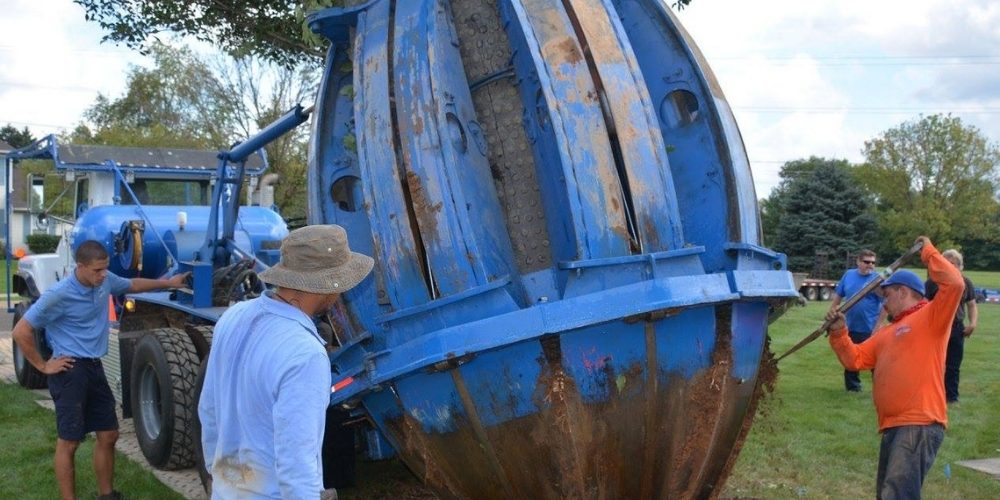
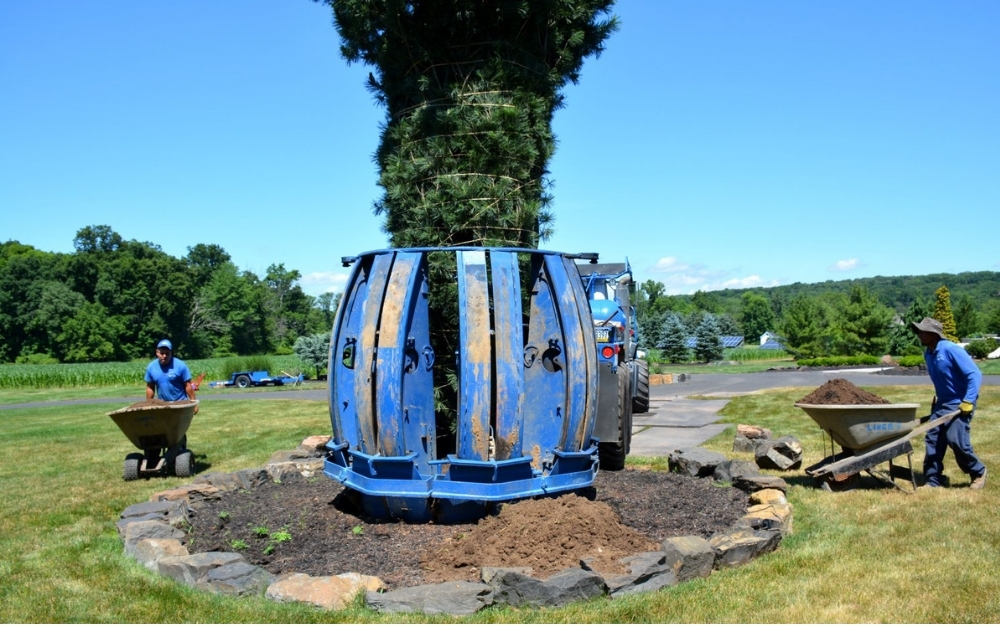
The rule governing all of this is the relationship between trunk diameter and root ball diameter: roughly ten to twelve inches of root ball for every inch of trunk caliper, and more for the difficult species. That is why a modest-looking tree requires a surprisingly large machine. A six-inch caliper tree needs a root ball in the range of five to six feet across, and a ball that size filled with Bucks County clay is enormously heavy. The machine size follows the root ball, and the root ball follows the tree.
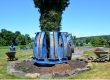
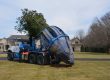
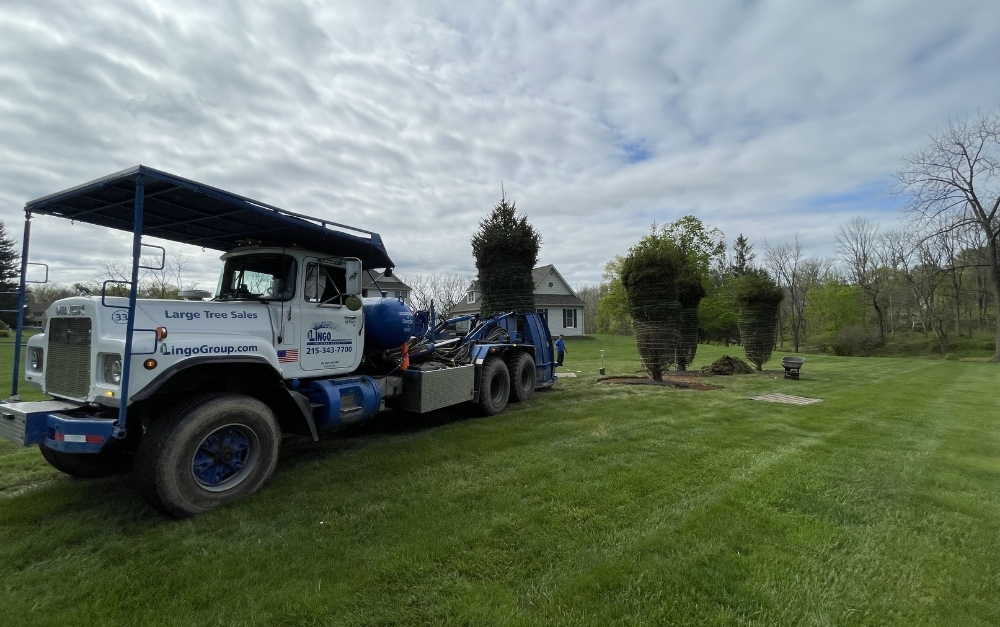
We use truck-mounted tree spade equipment capable of relocating mature trees up to approximately 30 feet tall, depending on species and trunk diameter. Where a tree exceeds what the spade can handle, the alternative is hand-digging and wire-basketing, which is slower and more expensive but sometimes the only path.
Clay Holds the Ball Together and the Water In
Much of the county consists of silt loam over clay, shale, or rock, and each layer changes the work in its own way:
- Clay holds a root ball together well, which is genuinely helpful during the move, but it drains poorly. A tree set into a tight hole in heavy clay can end up sitting in standing water, and more transplanted trees are lost to drowning here than to drought.
- The planting hole should be wide rather than deep, with the root flare at or slightly above finished grade, never buried.
- Shallow rock is the local surprise. In parts of Buckingham, Solebury, and the upper townships, excavation can hit refusal well above the planned depth, which changes the receiving site and occasionally the choice of tree.
Aftercare Decides the Outcome
The transplant itself takes a day. Establishment takes two to three years, and most of it comes down to water. A newly moved tree benefits from deep, infrequent watering rather than a light daily sprinkle, so that moisture reaches the bottom of the root ball and encourages roots downward. That schedule continues through the first autumn until the ground freezes, resumes the following spring, and carries on through at least two full growing seasons. Mulch belongs in a broad, shallow ring, never piled against the trunk.
Two local considerations deserve mention. Deer pressure in Bucks County is significant, and a stressed transplant is precisely the tree that gets browsed or rubbed, so protection through the first winters is a necessity on most properties rather than an option. And where a property runs on well water, establishment watering has to be planned around what the well can actually sustain, because it is an ongoing demand rather than a one-time task.
Forty Years of Growth You Do Not Have to Wait For
Two motivations account for most of this work. In the first case, a mature tree stands in the way of a building project, a driveway, a pool, or a septic field, and relocation is the alternative to losing it. In the second, and more common, case, a property needs structure now rather than in fifteen years. A newly built or newly landscaped property can look sparse for a very long time, and moving semi-mature trees into place gives the landscape its bones immediately. On a large open property, the tree line and the approach do more visual work than any planting bed.
Talk to Us Before the Window Closes
The Lingo Group has been working on Bucks County properties since 1982. You can read more about our tree transplanting and installation service, and about tree transplanting in Bucks County, including what drives the cost.
We move and install trees across the county, including Doylestown, Chalfont, Warrington, Newtown and Buckingham, where large properties and long approaches make specimen tree work especially worthwhile. Call (215) 343-7700, Monday to Friday, 8:00 AM to 4:00 PM. Autumn scheduling fills early.