
Privacy Trees: Plant or Transplant?
February 23rd, 2026
Privacy trees solve a visibility problem immediately, but how you install them determines whether you wait five years for screening or enjoy it this season.
Across Bucks County and Chalfont, we see the same concern from estate owners and commercial property managers: new construction behind a property line, expanded parking lots, neighboring second-story additions, or road widening projects that eliminate natural buffer. The question becomes practical, not aesthetic , do we plant young privacy trees and wait, or do we transplant mature trees for instant coverage?
The answer depends on goals, budget, and timeline. Below, we break down privacy shrubs, evergreen privacy trees, the fastest growing privacy trees, and how transplanting mature specimens changes the equation entirely.
Start With Structure: Privacy Shrubs vs. Privacy Trees
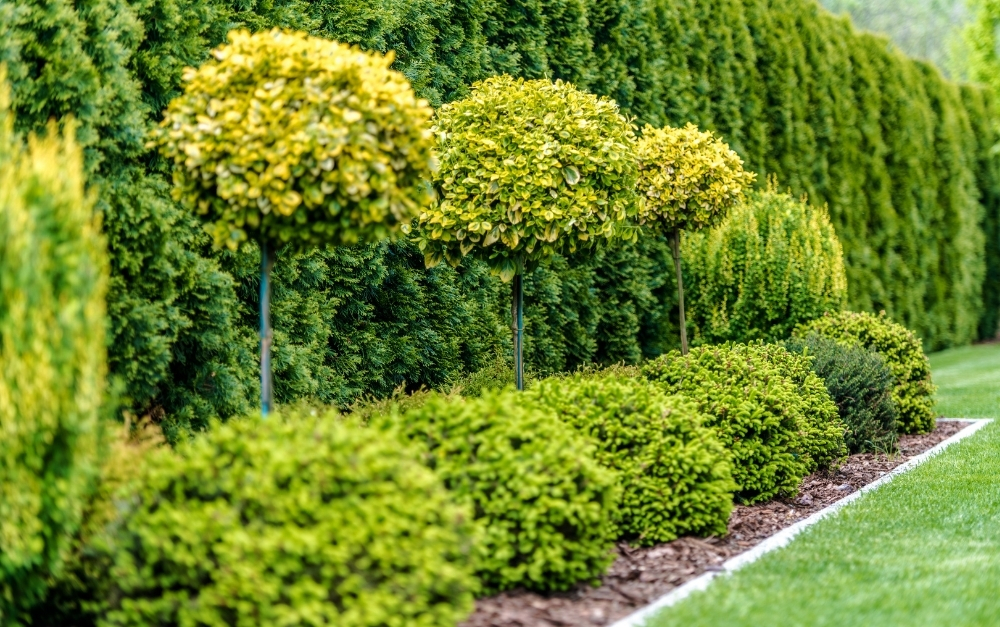
Here are the shrubs we most often recommend for long-term screening:
✓ Green Giant Arborvitae (maintained as hedge form)
✓ Skip Laurel (Prunus laurocerasus ‘Schipkaensis’)
✓ Boxwood (for formal lower borders)
✓ Inkberry Holly (native evergreen option)
These shrubs typically reach:
- Arborvitae hedge: 12–20 feet if allowed to mature
- Skip Laurel: 8–12 feet
- Boxwood: 3–6 feet
- Inkberry Holly: 5–8 feet
Most shrubs establish within 1–2 growing seasons but require 3–5 years to create a fully dense privacy wall when planted at standard nursery sizes (3–5 gallon or 5–6 foot height).
Lifespan ranges from 20–50+ years depending on species, pruning practices, and soil conditions.
Shrubs are ideal when:
✓ The privacy need is moderate
✓ Space is limited near property lines
✓ You want layered depth, not just vertical height
However, shrubs alone rarely solve second-story privacy issues. That’s where evergreen privacy trees become critical.
Evergreen Privacy Trees: The Traditional Approach
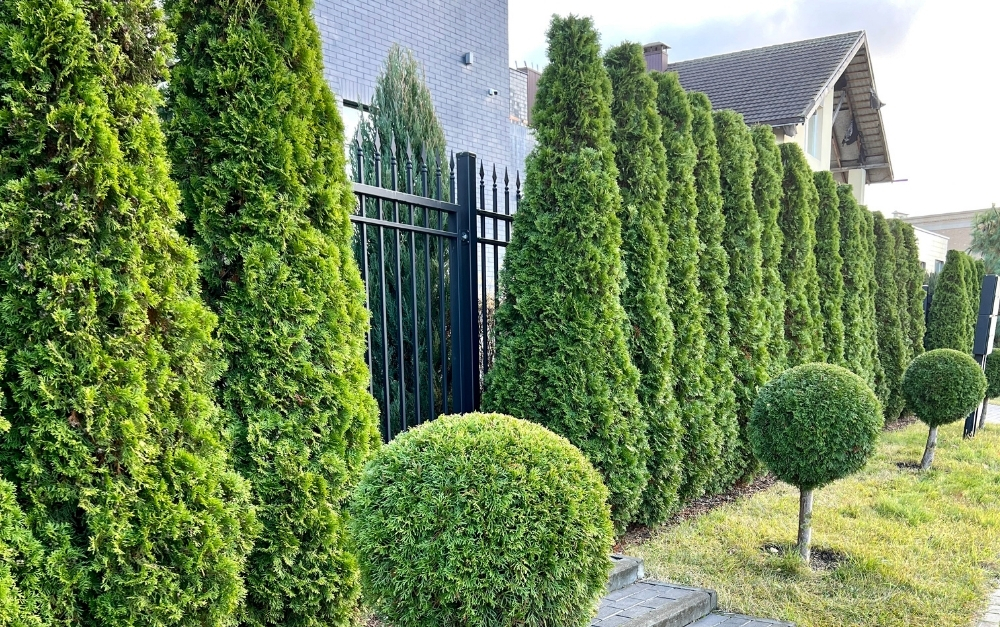
Evergreen privacy trees are the backbone of screening in Pennsylvania because they maintain foliage year-round. Unlike deciduous trees, they do not lose leaves in winter , which matters when sightlines are most exposed.
The most common evergreen privacy trees we install include:
- Norway Spruce
- Emerald Green Arborvitae
- American Holly
- Leyland Cypress
Growth Rate Comparison
| Tree Type | Annual Growth Rate | Mature Height | Typical Lifespan |
| Norway Spruce | 1–2 feet per year | 40–60+ ft | 80–100+ years |
| Emerald Green Arborvitae | 6–12 inches per year | 12–15 ft | 25–40 years |
| Leyland Cypress | 2–3 feet per year | 40–60 ft | 20–30 years |
| American Holly | 6–12 inches per year | 20–30 ft | 50+ years |
If you plant a 6-foot Norway Spruce, you may wait 5–7 years before achieving a meaningful 15-foot screen.
That timeline is the key decision point.
According to the USDA Plant Hardiness Zone Map, Bucks County sits in Zone 7a, meaning plant selection must tolerate freeze-thaw cycles and winter wind exposure. Improper species choice leads to winter burn, dieback, and thinning , which compromises privacy density over time.
When planted young, privacy trees require:
ⓧ Several years before effective screening
ⓧ Ongoing structural pruning to prevent thinning
ⓧ Irrigation support during establishment
For some property owners, waiting is acceptable. For others , especially commercial sites , it is not.
The Fastest Growing Privacy Trees: Does Faster Mean Better?
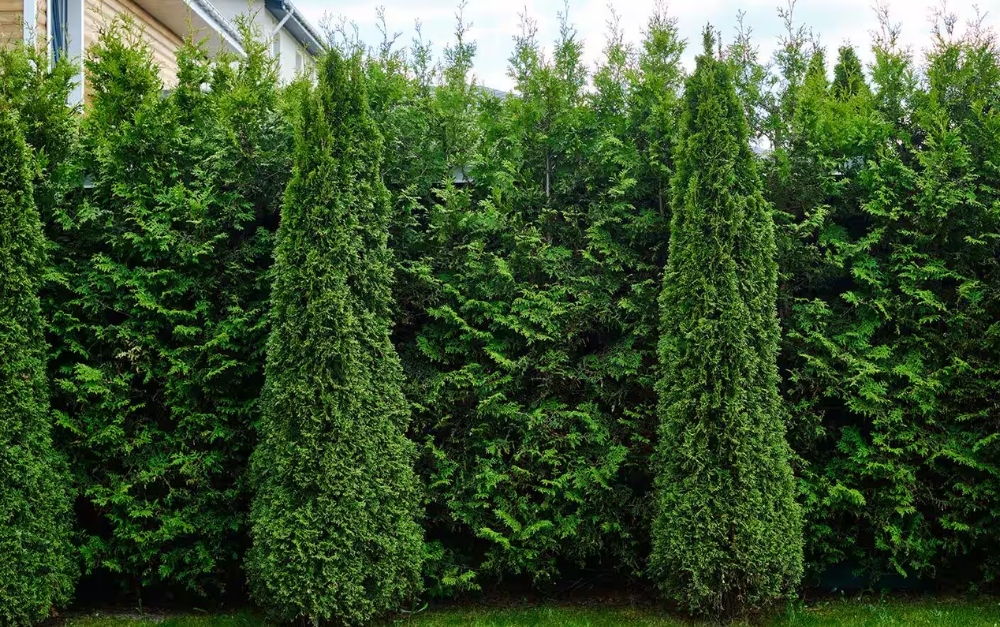
Fast growth sounds attractive. But in our climate, growth rate directly affects structural strength and longevity.
Leyland Cypress and certain hybrid arborvitae can grow 2–3 feet per year. That seems ideal , until root systems fail under heavy snow load or wind events.
The Pennsylvania State University Extension notes that fast-growing species often trade density and durability for speed (Penn State Extension). In Bucks County clay soils, this trade-off becomes more pronounced.
Here’s the reality:
| Option | Time to 15 ft Screen | Structural Stability | Long-Term Maintenance |
| Plant 6 ft Fast Grower | 3–5 years | Moderate | Moderate to High |
| Plant 6 ft Moderate Grower | 5–7 years | High | Low to Moderate |
| Transplant 18–25 ft Specimen | Immediate | High (if installed correctly) | Low |
The third option changes everything.
Transplanting Privacy Trees: Immediate Results
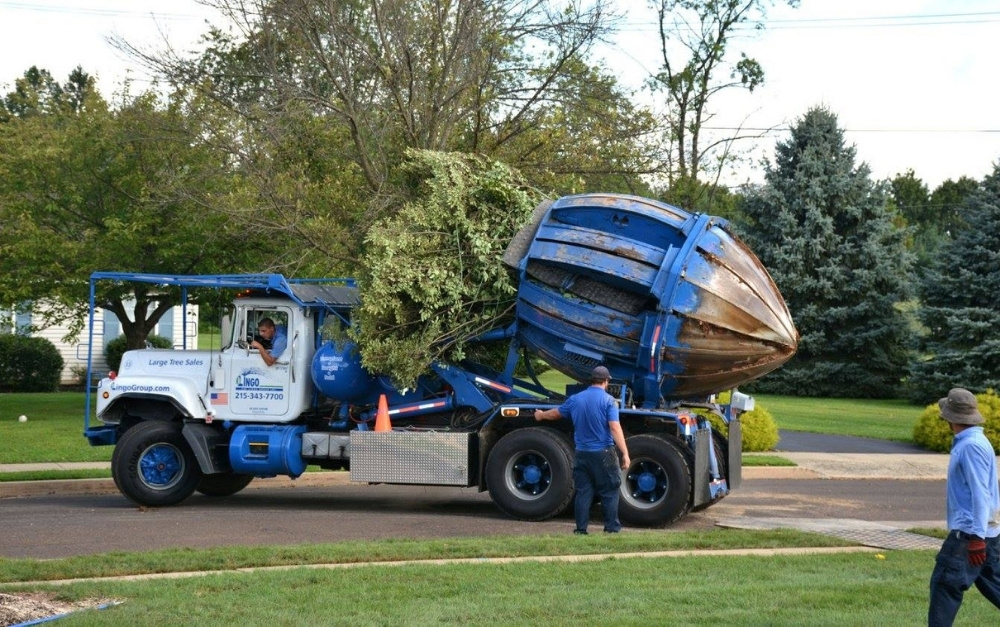
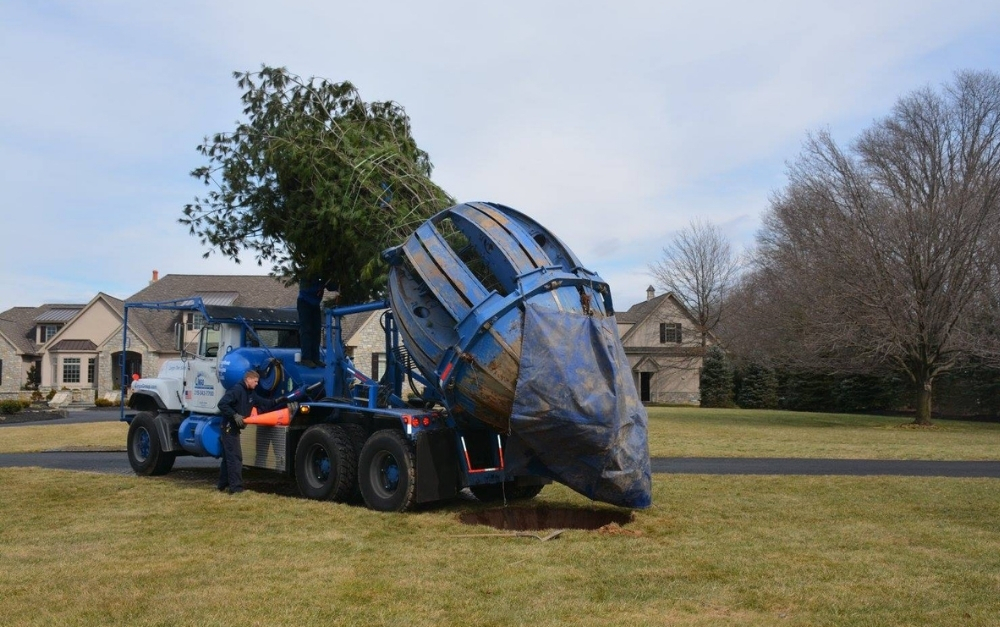
The Lingo Group using our hydraulic tree spade to instantly install mature trees.
Transplanting changes the timeline from years to days.
Instead of planting 6-foot trees and waiting, we can install:
- 16–20 foot Norway Spruce
- 18–22 foot Green Giants
- Large American Hollies
- Specimen evergreen groupings
The privacy impact is immediate. No gap years. No interim exposure.
Transplanting is ideal when:
✓ A commercial property needs immediate screening
✓ A new home build eliminated natural buffer
✓ Storm damage removed mature trees
✓ Neighboring development created new sightlines
This is especially common after wind and ice events in Chalfont, where mature trees are lost in a single storm.
Field Note
When transplanting mature privacy trees, the most critical factor is root ball preservation. Large-caliper trees must be moved with a mechanical tree spade that maintains soil structure and feeder roots. If roots are damaged or compacted, survival rates drop significantly within 12–24 months.
Choosing the Right Path Forward
The question is not simply “Which privacy trees grow fastest?” The better question is:
How long are you willing to wait for privacy?
If the answer is five years, planting smaller evergreen privacy trees is appropriate.
If the answer is this season, transplanting mature privacy trees is the more efficient solution.
Both approaches can work in Bucks County, but only when soil, spacing, and species selection are handled properly.
If you are evaluating privacy trees for a commercial property or estate in Chalfont or the surrounding region, we recommend a site evaluation to assess sightlines, soil structure, drainage, and equipment access.
You can schedule a consultation directly through our Contact Us page, or explore our full tree installation and transplanting capabilities on our Tree Transplant page.
Privacy is a long-term investment. Whether you plant or transplant, the installation method will determine whether that investment matures into a dense, lasting screen , or becomes another replacement project in five years.