
Landscape design in Bucks County happens in the months when nothing is growing. The plans drawn in January are the ones installed in April. Projects that start as a phone call in May tend to sit half finished through July. Winter is quiet on the job sites and busy at the drafting table, and that order is not an accident.
The Lingo Group has designed and installed landscapes across the county since 1982. We still run out of the same yard on Timber Lane in Chalfont. Below is how the work actually gets planned, plus what the ground here forces a plan to deal with.
What the Ground Decides Before Anyone Picks a Plant
Every landscape design in Bucks County answers to the soil first. Most of the county sits on silt loam over clay and shale. Water moves through it slowly. So a planting bed cut into badly graded ground behaves like a bathtub. That single fact kills more new plantings here than deer or drought ever do.
Frost adds the second constraint. The frost line runs to roughly three feet. Anything carrying a footing has to sit below it, which means steps, walls, piers and posts all get drawn at that depth rather than adjusted in the field later.
Then there is the plant palette. Bucks County straddles the 6b to 7a line on the USDA plant hardiness map. That narrows what survives a bad February. Deer pressure narrows it again. Across the townships, browsing is heavy enough that plant selection becomes a design decision instead of an afterthought. To see what your own parcel sits on, the NRCS Web Soil Survey maps the soil series under it.
The Order Everything Gets Solved In
A landscape design in Bucks County gets sequenced, not assembled. Grade and drainage come first. Every other decision depends on where water arrives and where it has to go. Circulation comes second, meaning the route from driveway to door to patio and how wide it needs to be.
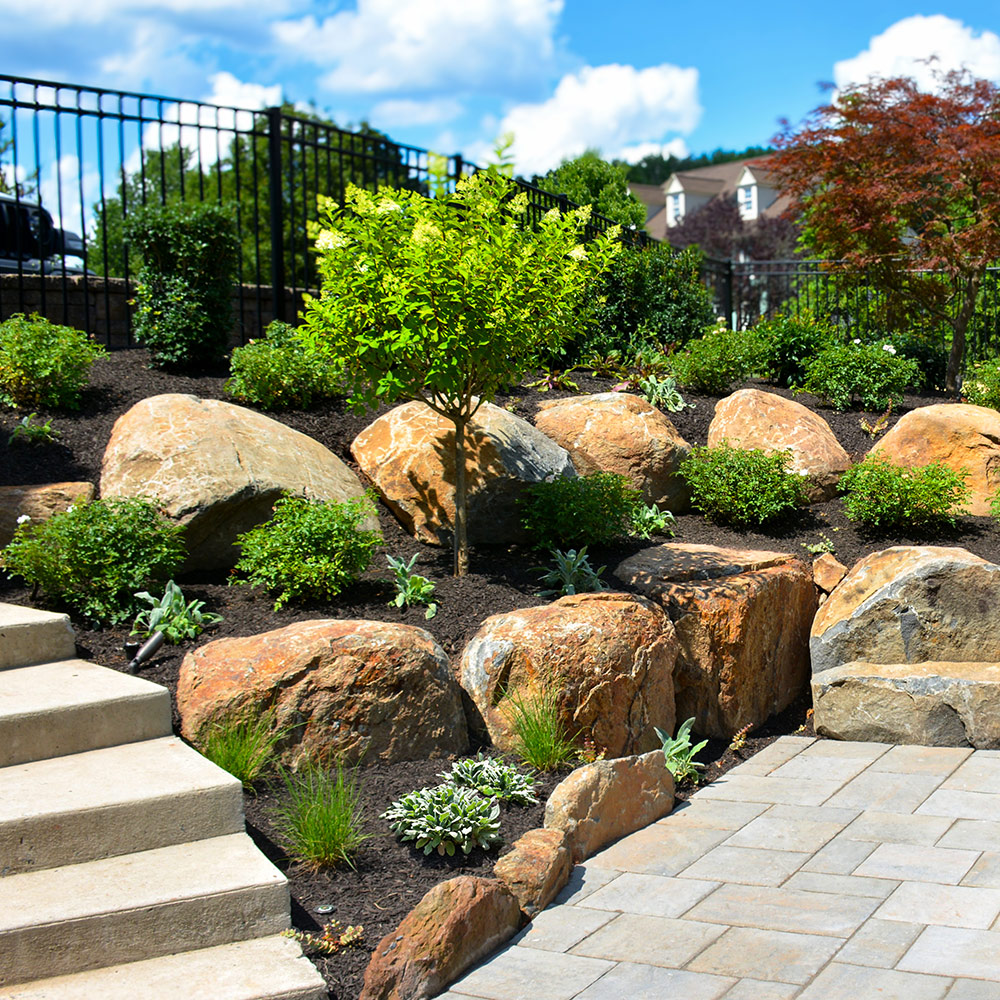
Structure follows. Walls, steps, terraces and bed lines establish the shape of the space before a single plant goes in the ground. Planting comes next, chosen for the light, soil and exposure it will actually live in. Size it for year five, not for what fits in the truck today.
Phasing closes it out. Work built in year two should not tear up what went in during year one. Skip that step and you pay twice for the same patio.
Drawn in January, Dug in April
Construction work in the county runs from spring through late fall. Planting is strongest in spring and again in early fall. Design, meanwhile, has no weather requirement at all. That is exactly why winter is the right time to do it.
There is a scheduling reason too. Install calendars fill in the order plans get approved. A design finished in February earns a spring slot, while the same design finished in May lands in late summer. Permitting, township review and material lead times all run on the same clock. A historic property in a borough district may need review before anything is ordered, and that process does not speed up because the weather turned nice.
What Shows Up on the Drawing
A landscape design in Bucks County starts with a consultation and a site analysis. We walk the property. We look at how water moves across it, note the light and flag existing material worth keeping. Then we listen to how the space actually gets used.
From there the ideas become visual plans you can read without a design background. The proposal that goes with them is itemized. You see what each piece of the project costs instead of one number at the bottom of a page. That matters most when a budget forces a choice between the terrace and the planting, because you can see exactly what moving a line item does.

Budgets Behave Better When a Landscape Design in Bucks County Is Phased
Few properties get built in a single season. There is nothing wrong with that. Trouble starts when a project gets built in pieces without a plan tying them together. Then the irrigation goes in before the grading is fixed, or the patio gets poured where the drain line needs to run.
A phased plan sets the order. Grading, drainage and underground work go first. They are the cheapest things to do before the hardscape and the most expensive to redo after. Structure follows, then planting, then the finish work. You can stretch that across three seasons without losing a dollar of it.
One Company From Sketch to Final Walk
Because we install what we draw, the drawings have to survive contact with real soil, real grade and a real budget. A designer who never has to build the plan can draw anything. A designer handing it to his own crews in April cannot.
Design, installation and maintenance are divisions of the same company here. So there is one point of accountability instead of a designer and an installer pointing at each other. Hardscaping and masonry, irrigation, lighting and turf care are handled in house as well. That keeps the plan intact through the parts of the job most companies subcontract out.
The Lingo Takeaway
Design season and build season are two different things. Winter is when a landscape design in Bucks County gets thought through properly. Spring is when crews and material get committed. Properties that treat those as one step in April end up with a shorter plan, a later install date and fewer options. Start with grade and drainage. Get the whole property on paper even if you build it over three years, and let the sequence do the work.
Common questions
When should I start a landscape design in Bucks County for a spring install?
Winter, and earlier is better. Plans approved in January and February get the first spring slots. A plan approved in May is usually looking at a late summer install.
Do I need a full design, or can you just plant some beds?
Both happen. However, if water collects anywhere on the property, or if you expect to build in stages, a plan pays for itself by getting the order right the first time.
How much does a landscape design cost?
It depends on the size of the property and how much of it is in scope. We quote design after the site walk rather than over the phone. The proposal is itemized, so you can see what each part carries.
Will deer ruin the planting?
Deer pressure is real across the county, and we plan around it instead of pretending otherwise. That means a backbone of material deer generally leave alone, with the vulnerable plants kept close to the house or protected. Penn State Extension publishes regional guidance on browsing resistance that holds up well here.
Can you fix drainage as part of the design?
Yes, and it is normally the first thing addressed. Most standing water here traces back to grade, a downspout dumping at the foundation, or beds built on compacted builder subgrade. Our write-up on drainage solutions in Bucks County covers how those get corrected.
By town
Every town in the county brings something different to a plan. Borough properties deal with tight access and historic review. Township developments sit on compacted builder subsoil, with drainage that was never properly finished. Larger acreage brings well water limits and structural grade.
- Landscaping in Doylestown, PA
- Landscaping in Newtown, PA
- Landscaping in Warrington, PA
- Landscaping in Chalfont, PA
- Landscaping in Buckingham, PA
Yardley, Langhorne, New Hope and the surrounding townships are within range as well. More detail on the full service sits on our landscaping page.
Start the Drawing While the Ground Is Frozen
If you want a landscape design in Bucks County ready before the spring calendar fills, now is the time to walk the property with us. Call (215) 343-7700 Monday through Friday, 8:00 AM to 4:00 PM, or use the contact page. Tell us the town and the property, and we will tell you honestly whether we are the right fit.