

Water decides more on a Bucks County property than most owners expect. So drainage solutions in Bucks County, PA start with one question. Where does the water end up once it leaves the roof? A wet corner of lawn is rarely the problem. It is the receipt.
We work out of our yard on Timber Lane in Chalfont. Since 1982 we have been landscaping in Bucks County, so we have walked a lot of soggy back yards and a lot of ponding parking lots. The pattern repeats. Water shows up where it was never routed, and everything downhill of it pays.
What the Ground Here Does With a Two Inch Rain
Most of Bucks County sits on silt loam over clay and shale. That ground drains slowly. Once it saturates, it stops accepting water almost entirely. So a storm that would soak into sandy ground in an hour sits on the surface here and runs.
Compaction makes it worse. Clay packs hard under equipment, foot traffic and years of mowing. Packed clay then behaves like pavement. Penn State Extension keeps a plain overview of how residential ground sheds stormwater, and it matches what we see in the field.
Then there is frost. Frost depth around here runs to roughly three feet. Anything carrying a footing has to sit below that line. Shallow work heaves, heaved work shifts grade, and shifted grade sends water somewhere new. Drainage solutions in Bucks County have to work with that ground rather than argue with it.
Three Places It Usually Starts
The first is the downspout. A leader dumping against the foundation puts hundreds of gallons in the worst possible spot. Carrying that discharge away from the house solves more wet basements than any other single move. Plenty of drainage solutions in Bucks County start and end right there.
Second is grade. Builder grading on township developments was often minimal. Minimal grading tends to settle the wrong way within a few seasons. Water then arrives at the house instead of leaving it.
Third is the planting bed. A bed dug into native clay and backfilled with soft soil becomes a bathtub, because the clay walls hold the water in. Plants drown in beds like that. Meanwhile the lawn ten feet away stays dry. Compaction in the turf is a cousin of the same problem, which is why aeration matters on clay ground.
Drainage Solutions in Bucks County Start at Grade, Not at Pipe
Every proposal we write starts with grade and drainage. That order is not a preference. Nothing built above it survives if the water is wrong.
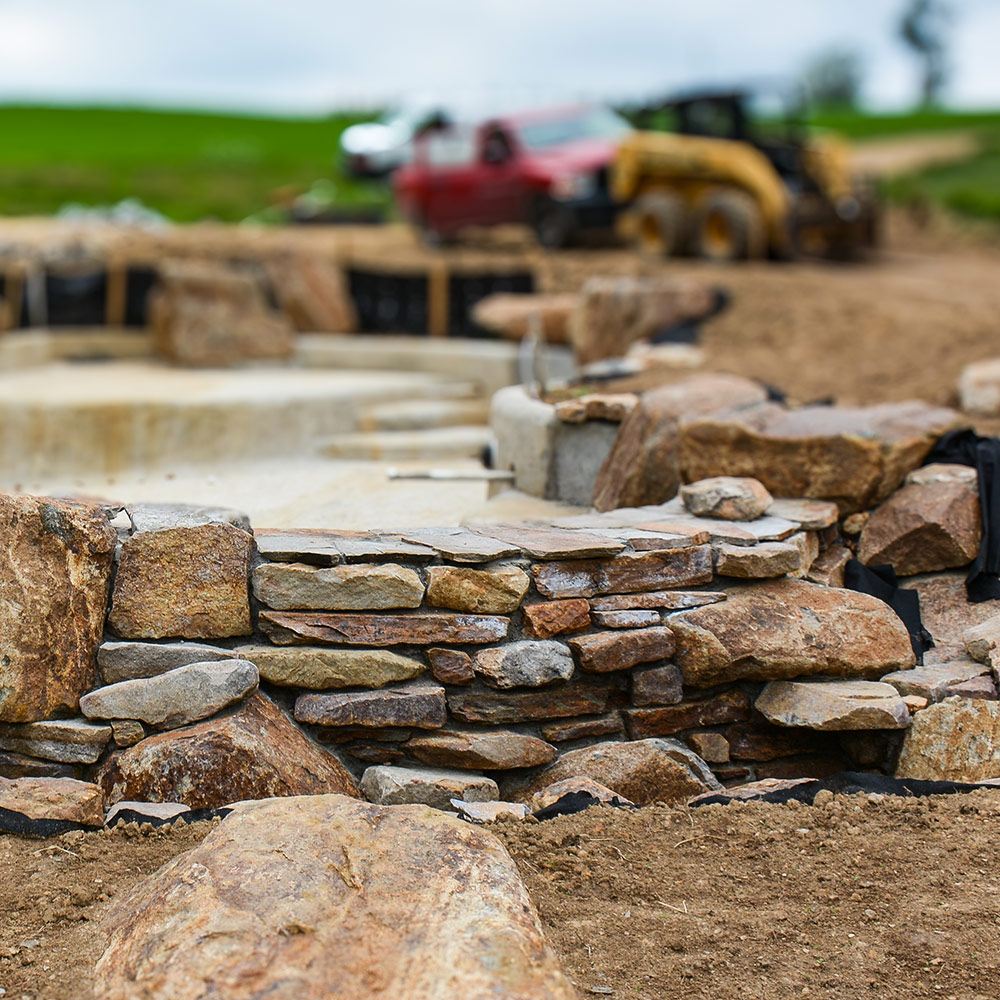
So we look at where the roof leaders discharge. Then we find the real low point of the property. We also read how the neighbor’s grade meets yours. Circulation and structure come next, and planting comes last. Patios and walls fail here for the same reason, which is why hardscaping and masonry work gets a real base instead of undisturbed clay.
Because we install what we design, the drawing has to survive real soil and a real budget. There is no gap between what the plan says and what the crew builds. You can see the rest of that scope on our landscaping and landscape design page.
The Parts You Pay For Once and Never See Again
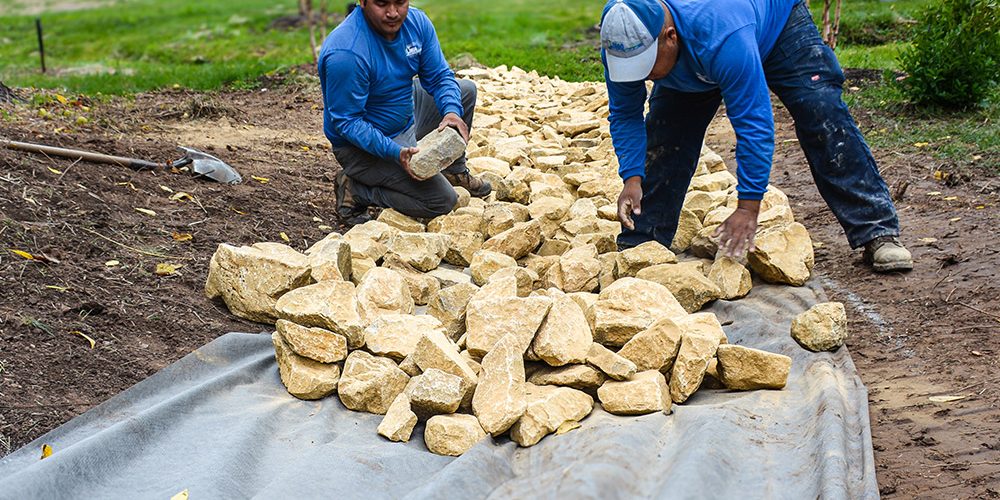
After grade is corrected, most of the remaining work is buried. Perforated pipe set in stone. A basin at a low point. A dry well sized to the roof area feeding it. None of it photographs well.
The outlet separates a fix from a delay. Pipe has to daylight somewhere lower, or reach something with real capacity. Otherwise it moves the puddle and buys a season. Larger jobs can also fall under earth disturbance rules. Before anyone digs, read the small projects guide from the Bucks County Conservation District.
Access shapes the fix too. On tight borough lots, the largest machine that reaches the back yard is often a mini skid steer. So the approach gets settled before the design is finished. Walls holding a new grade need the same discipline, and we cover that in our piece on retaining walls in Bucks County.
Lots, Islands and the Number a Board Has to Approve
Commercial ground has the same soil and a tighter clock. Ponding at a lot low point is a trip hazard in October. In January it is a sheet of ice. So drainage and winter risk are one conversation. Our commercial snow management runs out of the same yard, which keeps both sides of it honest.
Curbed islands and planters are the usual culprits. They collect runoff, they hold it in clay, and then they push it back across the asphalt. Boards tend to find out when a tenant complains. Sometimes an insurer asks first.
Budget season matters as well. Most associations set numbers in the fall. So drainage solutions in Bucks County scoped in November have a real chance of funding by spring.
A Wet November Reads Better Than a Dry June
Saturated ground tells the truth. After a long soaking rain you can see the low points and the sheet flow. You can also see the mulch that washed out and the inlet that leaves have sealed shut. The National Weather Service office in Mount Holly tracks storm totals for this area. A two inch event is the one worth walking.
Winter adds a second read. Where snow melts first, water is moving. Where it sits as a gray crust for a week, water is not going anywhere.
Design is also better work for the cold months. The jobs drawn in January are the ones installed in April rather than August.
The Lingo Takeaway
Drainage is cheap to fix early and expensive to fix late. So walk the ground during the next real rain. Photograph the water and note the time. Then look at your downspouts before you look at anything else.
If the grade is wrong, correct the grade first. Pipe added to bad grade is a payment plan on the same problem. Drainage solutions in Bucks County hold up when they start at the bottom and work upward.
Common questions
Is standing water in my yard a landscaping problem or a plumbing problem?
Usually it is a landscaping problem. Most standing water here traces back to grade, a downspout at the foundation, or beds built on compacted builder subgrade. We look at those three before anything else.
How long does drainage work take?
It depends on the property size and the access. A downspout correction with some regrading is often a short job. A full regrade with buried pipe takes longer, and it needs ground dry enough to work on.
Can drainage work happen in winter?
Some of it can, as long as the ground is not frozen through. Design and scoping run all winter. Construction generally runs spring through late fall.
Will new drainage push water onto my neighbor?
It should not, and that is part of the design. Water has to leave in a direction with capacity for it. So we read the neighboring grade before committing to an outlet.
Do you handle commercial drainage as well as residential?
Yes. Grading and drainage sit at the centre of what we do on both. Drainage solutions in Bucks County get scoped around each property’s own risk profile.
By town
The soil behaves the same across the county. But access, review and property type change block by block. These pages cover what we actually run into, so drainage solutions in Bucks County read a little differently in each one.
- Doylestown, PA landscaping, narrow borough lots plus township grade along Route 611 and Route 202
- Warrington, PA landscaping, the commercial corridor and townhome communities
- Newtown, PA landscaping, planned communities and HOA ground where consistency counts
- Buckingham, PA landscaping, acreage, long driveways and structural grade
- Chalfont, PA landscaping, our home borough and the yard the crews leave from
We also work in New Britain, Warminster, Perkasie, Sellersville and the surrounding townships. If your property is nearby and not listed, call and ask.
If water is showing up where it should not, call the office at (215) 343-7700, Monday through Friday, 8:00 AM to 4:00 PM. You can also use our contact page. Tell us the town and the property, and we will tell you honestly whether we are the right fit.