
Lawn fertilization in Bucks County, PA is less about the bag and more about the ground under it. Most lawns here sit on a few inches of builder topsoil over clay. So lawn fertilization in Bucks County, PA works with a root zone that is shallower than it looks. Feed that lawn like deep loam and you waste half of what you put down.
Four decades of turf work here teaches the same lesson over and over. The lawns that hold color through July are the ones on a program. One spring application and a hope is not a program.
What the Ground Here Gives Back
Central Bucks is shale and clay country. Dig a test hole in a Doylestown Township development, or off Lower State Road in New Britain. You hit dense orange-brown subsoil fast. Builders spread four inches of topsoil over ground that trucks packed down for a year. Then they laid sod on top.
That shapes how lawn fertilization in Bucks County, PA has to be delivered. Nutrients move slowly through compacted clay, and water runs sideways instead of soaking in. So a heavy single application tends to leave the lawn rather than enter it. It heads for the curb line and the storm drain.
Our soils also run acidic. Acidic ground locks up nutrients the grass already has. That is why a lawn can look hungry while the fertilizer sits there unused. Lime belongs in that conversation too. Fall suits lime better than spring here, because freeze and thaw cycles work limestone down into the profile.
Four Visits, Not One Bag
A real program splits the year into visits. Each one does a different job. Spring brings the lawn out of dormancy without pushing it into a growth spurt it cannot support. Early summer carries it toward the heat. Late summer starts the recovery. Fall does the heaviest lifting of the four.
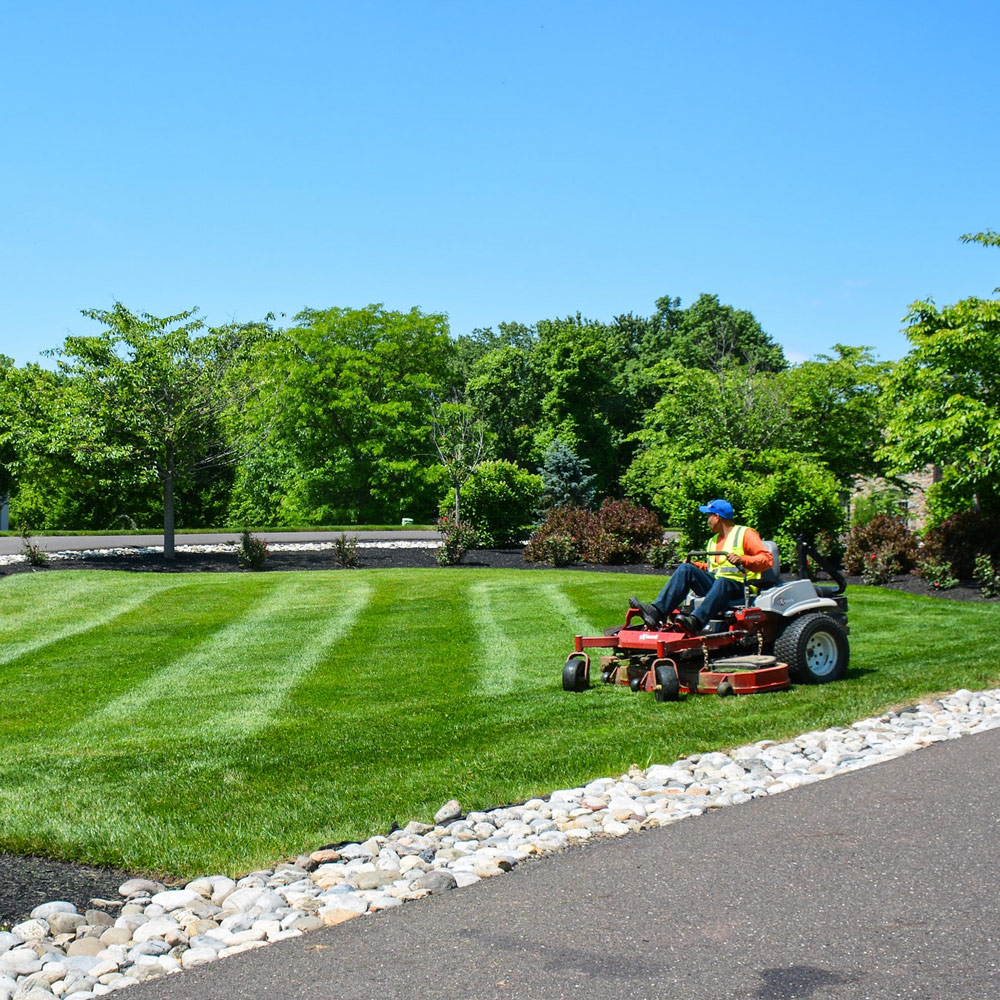
Rates stay modest on purpose. Slow-release nitrogen feeds over weeks instead of flooding the plant in three days. That suits clay ground well. Granular product also needs a calibrated spreader. An uncalibrated one stripes a lawn in a way you will see all season.
Weed control usually rides along with these visits. Our turf management program sets fertilization, weed and pest control, aeration and overseeding against what the property actually faces. We look at soil quality, grass type and sun exposure before anything goes on the lawn.
Lawn Fertilization in Bucks County, PA, and the Calendar
Fall is the season that pays. Cool air slows top growth while the soil holds its summer warmth. So the plant sends energy into roots and crown instead of blades. One slow-release application in that window beats two in May.
Late October still sits inside that window in this county. By late November, growth has mostly stopped. Anything applied past that point waits on the surface for spring rain. That is a different thing from feeding the lawn.
Seeding runs on a tighter clock than feeding does. Penn State does not suggest seeding after mid-October for most of Pennsylvania. So by now the honest plan pairs lawn fertilization in Bucks County, PA this fall with seed in the spring window. We would rather tell an owner in Warrington that straight.
The Rules Nobody Reads Until They Matter
Pennsylvania revised its fertilizer law in July 2022, and the limits are specific. Plant available nitrogen caps at 0.7 pounds per 1,000 square feet per application. Total nitrogen caps at 0.9 pounds unless the product is an enhanced efficiency fertilizer. Those numbers rule out the one-and-done approach on their own.
Phosphate comes with a tighter rule. Under the state fertilizer rules for homeowners and applicators, no phosphate goes down at all. The exception is establishing, reestablishing or repairing turf. The law also sets a 15-foot buffer from the top bank of ponds, wetlands and flowing water. Plenty of properties in this county have a pond, so that line matters.
Three conditions stop the work entirely. Frozen ground, snow cover, and heavy rain in the forecast. Fertilizer is also never a de-icer. Spilled product on a sidewalk gets swept back onto the turf, instead of washing into a drain. Ask any contractor whether they comply with that law. A good one answers without pausing.
Where the Numbers Should Come From
Guessing costs money in both directions. You either buy nutrients the ground already has, or you miss the one it lacks. So lawn fertilization in Bucks County, PA should start with a soil test. One costs about the price of lunch.
Penn State Extension sells kits for $10.00 at the Bucks County office. Call 267-483-2020 first. Each kit holds a mailing bag, a form and a zip-top bag. After hours, there is a self-serve box outside the office. Their write-up on testing rather than guessing covers why the step is worth it. The Bucks County page has the mailing details.
Test results drive pH and phosphorus decisions. Nitrogen still runs on the label rate and the calendar. It moves through soil too fast for a test to pin down.
Commercial Lots, HOA Common Ground and the Curb Line
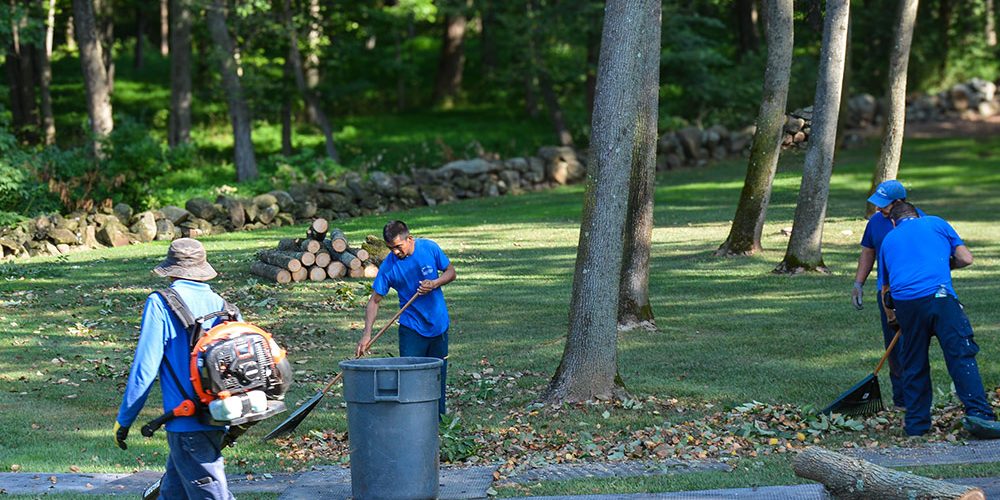
On commercial sites and HOA common areas, the lawn fails in patterns. The strip between the parking lot and the front door goes first. So does the shortcut everyone takes to the mailboxes. So does the band along the curb where plow spray and road salt land all winter.
Those strips need more than food. Compaction has to come out of them first, which is what core aeration is for. Salt damage along the curb needs leaching, and often reseeding. So lawn fertilization in Bucks County, PA goes on those lanes after the ground is open, not before.
Property managers along the Route 611 corridor in Warrington see the same map every year. So do boards in the planned communities around Newtown. Fall is also when those budgets get set, so this is the month the conversation happens. Keep leaves off the turf while you are at it. A wet mat of maple and oak smothers grass in about a week, and our fall cleanup walkthrough covers that sequence.
The Lingo Takeaway
Lawn fertilization in Bucks County, PA works when it respects three things. Shallow topsoil over clay, acidic ground that locks nutrients up, and a state law that caps what goes down per application.
So the plan is modest rates, spread across the season, with the heaviest work in fall. Then a soil test to settle pH and phosphorus. Compaction gets dealt with separately. We have cared for lawns in this county since 1982. The properties that look right in July are the ones where somebody fed the ground on a schedule.
Common Questions
How many fertilizer applications does a Bucks County lawn need?
Most cool-season lawns here do well on three to four visits a year at modest rates. State law caps nitrogen per application anyway. So splitting the year is both better agronomy and the only legal way to feed a full season.
Is late October too late to fertilize?
No. Late October still falls inside the fall window, and that is the most valuable application of the year. Once growth stops and the ground freezes, the work stops too.
Do I need a soil test before a program starts?
For pH and phosphorus, yes. A $10 kit from the Bucks County Extension office answers questions that guessing never will. Nitrogen timing does not depend on it.
Will lawn fertilization in Bucks County, PA thicken a hard, thin lawn by itself?
Rarely. If the ground is compacted, roots cannot use what you feed them, so aeration comes first. Shade, drainage and mowing height account for most of the rest.
Can the same visit handle fertilizer and weeds?
Often, yes. Pre-emergent and broadleaf timing lines up with several feeding visits. That is why both sit on one program instead of two schedules.
By Town
We care for turf across central and lower Bucks County. Start with the page for your area:
- Landscaping in Chalfont, PA, our home borough, where the crews and equipment sit on Timber Lane
- Landscaping in Doylestown, PA, borough properties with tight access plus township lawns on builder subsoil
- Landscaping in Warrington, PA, the Route 611 commercial corridor and townhome communities
- Landscaping in Newtown, PA, planned communities and HOA common ground
- Landscaping in Buckingham, PA, acreage properties and open ground
We also work in New Britain, Warminster, Perkasie, Sellersville and the surrounding townships. If your property sits nearby and is not listed, call and ask.
Set the Program Before the Ground Freezes
If the lawn went thin this year, now is the time to look at it. Call (215) 343-7700 Monday through Friday, 8:00 AM to 4:00 PM, or use our contact page. Tell us the town and the property. We will walk it, read what the soil is doing, and tell you honestly whether lawn fertilization in Bucks County, PA this fall or a spring start fits your lawn better.