

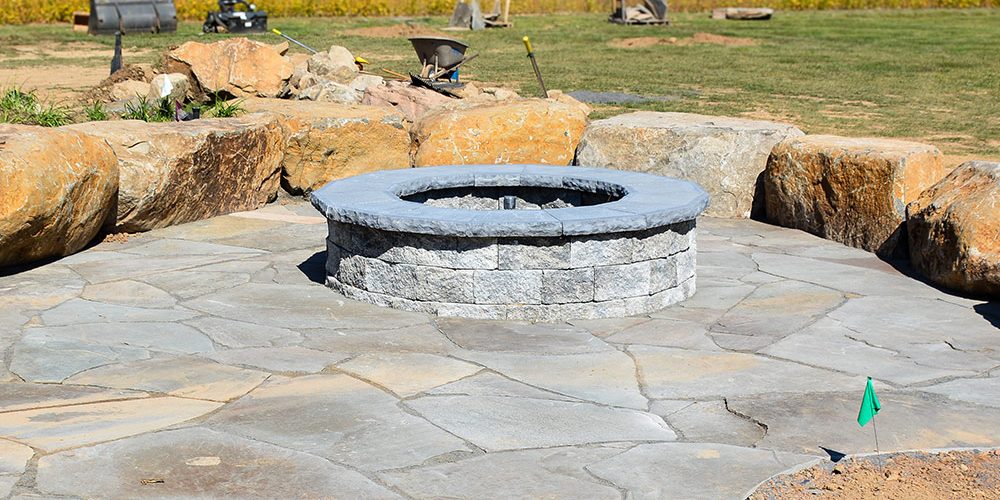
Fire pit installation in Bucks County looks easy in a photo. A ring of stone, a few chairs, and the yard has a place to sit in October. The build runs the other way around. Most of what decides whether that pit still sits level in ten years happens under the surface. We have designed and installed hardscaping here since 1982, out of our yard in Chalfont.
So the order of operations rarely changes. Before anyone talks about stone color, we walk the property and measure it. That visit sets the spot, the grade and the base depth.
Picking the Spot Is Half the Job
Smoke goes where the wind takes it. On a tight borough lot in Doylestown or Perkasie, the wrong corner sends all of it onto the neighbor’s deck. So we look at the prevailing wind first. Then we look at the house windows and the door everyone actually uses.
Grade matters just as much. Water moves downhill. A seating area dug into the low point of a yard becomes a basin after a hard rain. We also keep the fire ring out of the traffic lane between the back door and the driveway. Chairs pull out about two feet when people sit down, and that space has to come from somewhere.
Trees get a look too. Low limbs over a fire are a problem. Roots under the footprint are a bigger one. Older properties in Buckingham and Solebury often have both, so fire pit installation in Bucks County starts with a walk rather than a catalog.
The Work Nobody Photographs

Bucks County ground is mostly clay and shale. Both drain slowly. Water sits against whatever you build instead of moving past it. Then winter arrives, and that trapped water freezes and lifts the stone above it. Penn State Extension has a plain explanation of how freeze and thaw cycles move soil. The same physics works on a patio.
That is why every fire pit installation in Bucks County gets its base depth set on site, not copied off a spec sheet. The local frost line runs about three feet down. So we excavate, haul out what will not hold the build, and compact the base in lifts. The pit and the patio around it then sit on one surface. They settle together instead of apart.
Edge restraint and pitch come next. Pitch sends water off the field and away from the house. Skip either one, and the joints open up by the second spring.
Stone, Brick and What Sits Beside the Fire
We build with concrete pavers, clay brick, bluestone, natural stone, segmental block, dry-laid fieldstone and boulders. Each one reads differently next to a house. A fieldstone farmhouse off Route 413 wants dry-laid stone. A newer colonial in a Warrington development usually looks right with pavers and a brick accent.
Seat walls are worth raising early. We build them into the patio rather than setting them on top. The same goes for outdoor kitchens and for the pit itself. A wall tied into the base behaves like part of the structure. One dropped onto finished pavers telegraphs every shift underneath.
Material around the fire face is its own conversation. So we cover it at the design stage, along with cap stone, veneer and how the whole thing lines up with your existing masonry. Our guide to pavers, bluestone and poured concrete compares the materials. The Hardscaping and Masonry page shows the finished work.
Permits, Paint Marks and Your Township’s Fire Rules

Fire pit installation in Bucks County brings two kinds of paperwork. The first is the township permit. We pull what your township requires as part of the build. Thresholds vary by municipality. A retaining wall built alongside a patio commonly needs a permit at four feet, measured from the bottom of the footing.
The second is the locate request. Gas, electric and cable lines run through back yards at depths nobody can guess. So every excavation starts with a request to Pennsylvania 811 and the paint marks that follow. We handle that before a machine touches the ground.
Burning rules are separate, and they belong to your township. Hilltown Township allows recreational fires as an exception to its general burning ban. Its conditions are specific: natural untreated wood only, a fuel pile no larger than eight cubic feet, and a sober adult over 18 watching the fire. Extinguishing equipment has to be within reach. Nothing burns between 1:00 and 5:00 a.m., and nothing burns during a drought or an active burn ban. You can read Hilltown’s burning ordinance in full. Your township will have its own version, so check it before the first fire.
Fire Pit Installation in Bucks County on a Fall Schedule
Autumn is a good stretch for this work. The ground is still workable. Summer irrigation has stopped, and the yard is not fighting us for space. Crews also move faster in cool weather than in August.
Booking now has a second advantage. Spring fills up early, and the properties that call in March usually wait. Finish in November, and you get the use of the pit through the cold months. That is when a fire pit earns its keep anyway.
We run our own crews and equipment. So the schedule does not hinge on a subcontractor’s calendar. The sequence holds from the first visit to the last. Site visit and measurement, then a design with a line-item proposal. Then permits and utility marks, excavation and compacted base, installation, and a final walkthrough with you on the patio.
The Lingo Takeaway
Fire pit installation in Bucks County is an excavation and drainage project with a stone face on it. Base depth, compaction, pitch and the spot you choose decide how it ages. None of those get fixed later without taking the patio apart. So we measure before we quote, and we build the pit into the field rather than onto it. Most of these jobs get planned next to grading, planting and lighting, because a patio rarely lives alone in a yard.
Common Questions
How close to the house can a fire pit sit?
Close enough to be useful, far enough to satisfy your township and keep smoke off the back door. Setbacks and clearances differ by municipality. So we check your township’s requirements and your layout during the site visit, instead of working from a rule of thumb.
Do I need a permit for a fire pit?
It depends on where you live and what else goes in with it. Permit thresholds vary by township. A patio with a retaining wall often crosses a line a plain pit would not. We pull what the township asks for, and that step is already in the proposal.
Can a fire pit go into a patio I already have?
Sometimes, and the base decides it. We look at what sits under the existing field first. A pit tied into pavers that have already settled will keep moving with them. We also repair settled patios and failing walls that other crews built. The honest answer comes after someone stands on the surface and looks.
How long does fire pit installation in Bucks County take?
That depends on the size of the field and how much excavation the base needs. Access is the variable people underestimate, because a machine still has to reach the back yard. The line-item proposal lays out the scope and the schedule before anything starts.
By Town
We handle fire pit installation in Bucks County from our Chalfont yard. Each town brings its own grade, soil and permit office. Start with your area: Doylestown, Newtown, Warrington, Chalfont or Buckingham. We also work in Warminster, Jamison, New Britain, Hilltown and Solebury.
If a larger patio is part of the plan, our walkthrough of paver patio installation in Bucks County covers the base work in more detail.
Talk To Us About the Space
Ready to talk through fire pit installation in Bucks County on your own property? Call us at (215) 343-7700 or use the contact page. Someone from our crew will come out, look at the grade and drainage, and measure the area. Then you will hear what the site needs before you commit to anything.