
Irrigation on Well Water: Designing Systems for Bucks County Properties
A large portion of Bucks County runs on private wells rather than municipal water, and that single fact changes irrigation design more than anything else about a property. A system laid out as though it were connected to public water will perform beautifully in May and struggle visibly by the middle of July.
Irrigation was the first service The Lingo Group added after its beginnings in turf maintenance, and well capacity remains the design constraint we spend the most time explaining. Here is what it means in practice.
Flow Rate Governs the Design, Not Pressure
Homeowners naturally think in terms of water pressure, but the number that actually governs irrigation design is flow rate: how many gallons per minute the source can deliver continuously, rather than in a brief burst.
Every well has a recovery rate. Water is drawn out faster than the surrounding ground refills it, so the water level drops while the system runs and recovers when it stops. A system that demands more than the well can sustain will draw the level down until the pump loses prime or begins short-cycling, which is hard on the pump and, over time, expensive. Municipal supply behaves entirely differently, delivering steady flow for as long as it is asked to. That difference is why a zone layout copied from a public-water property onto a well is the most common design error we are asked to correct.
What a Bucket and a Stopwatch Tell Us
Designing within a well’s actual capacity leads to a few predictable adjustments:
- More zones, each smaller, running in sequence rather than a few large zones running together
- Longer total watering time, which is why well-water systems usually run overnight rather than in a short morning window
- A measured starting point: the well’s delivery should be tested, and the pump capacity, tank size, and recovery rate known, before a single zone is drawn
On properties where the well is genuinely marginal, the honest recommendation is sometimes to irrigate less ground rather than to irrigate all of it badly.
Not Everything Out There Earns a Zone
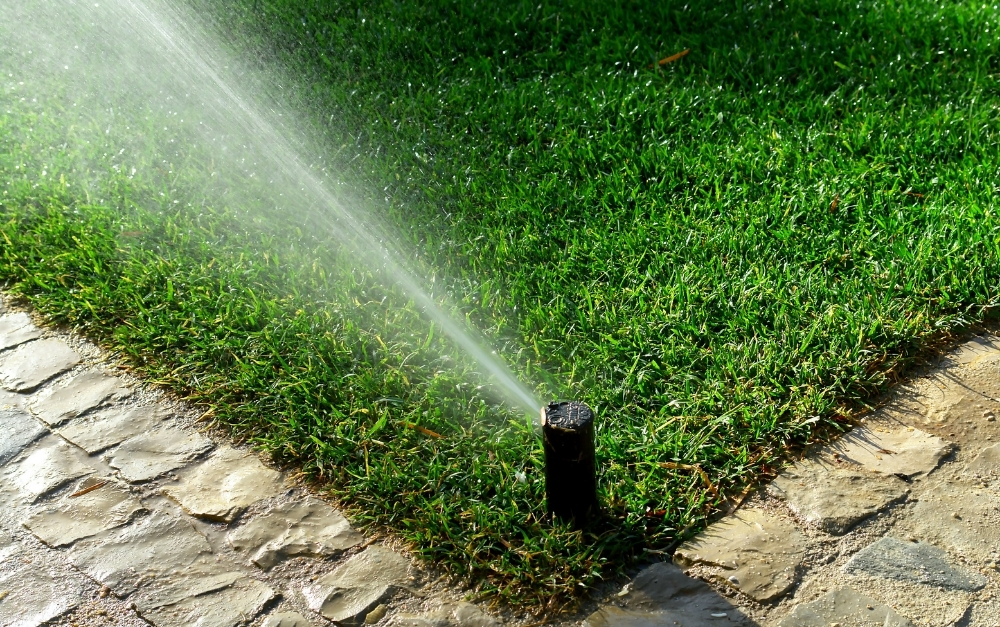
On larger properties, irrigating everything is rarely the right answer, and on a well it is often not a realistic one. The areas that genuinely justify irrigation are fairly consistent: new planting during its establishment period, the lawn nearest the house where appearance matters most, and containers or raised beds where root volume is small.
Established trees and shrubs that have been in the ground for several seasons generally need no supplemental water in a normal year. Neither does a large outlying lawn, which will go dormant in a dry August and recover on its own. Making these choices deliberately, rather than by default, is often what makes a well-water system workable at all.
Thirsty Things Together, Tough Things Together
Several grouping principles carry more weight on a constrained water supply:
- Plants with different water needs should not share a zone, because the schedule gets set for the thirstiest plant and everything else is overwatered. In the heavy clay under much of our topsoil, overwatering kills more established shrubs than drought does.
- Spray heads and rotors should never share a zone, since they apply water at very different rates; a run time that suits one is wrong for the other.
- Sun and shade belong on separate zones, as their demands diverge through the season.
- Slopes want shorter, repeated cycles, so water soaks in rather than running off downhill.
The Part the Township Will Ask About
Any irrigation system connected to a drinking water supply requires backflow prevention, so that water standing in the irrigation lines can never be drawn back into the water you drink. The assembly must match the hazard level and must be installed so it can be tested. This applies to residential and commercial systems alike, and it is a code requirement rather than an optional upgrade.
What Has to Happen Before the First Hard Freeze
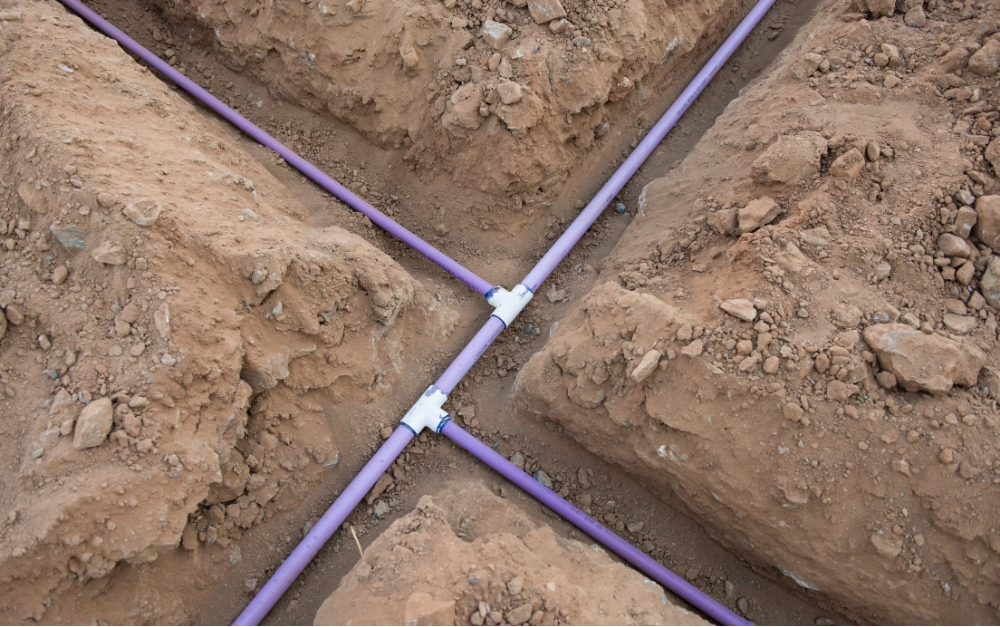
Water left in irrigation lines through a Bucks County winter will freeze, expand, and split pipes and fittings. Systems here need to be blown out with compressed air before the first hard freeze, zone by zone, with the backflow assembly drained and protected. Mainlines belong below the frost line, which runs to roughly three feet in this region.
Spring startup is the mirror image of the process: charge the system slowly to avoid a pressure surge, check every head, and re-aim the ones that winter has shifted.
The Pump Is Telling You Something
- Household water pressure drops noticeably while zones are running
- Heads pop up weakly, or the last heads on a zone barely rise
- The pump cycles on and off repeatedly during a watering run
- The system performs well in spring and poorly in high summer
- Some areas stay soggy while others burn out
Most of these are zone-sizing problems rather than equipment failures, and they can usually be corrected by re-splitting zones rather than replacing hardware.
Talk to Us About Your Water
Irrigation is named on our Pennsylvania Home Improvement Contractor registration, PA027076, alongside landscape contracting and low-voltage lighting. You can read more about our irrigation and water features service, and about irrigation system services including maintenance, winterization, and repair.
We install and service systems across Bucks County, including Doylestown, Newtown, Warrington, Chalfont and Buckingham, where well water is especially common. Call (215) 343-7700, Monday to Friday, 8:00 AM to 4:00 PM, and we will look at what your well can actually sustain before we design anything.