
Outdoor Lighting Design for Bucks County Properties
Outdoor lighting tends to fail in one of two directions. Some properties have too little of it, disappearing at dusk behind a pair of glaring floodlights over the garage. Others have far too much, spread at one uniform brightness, producing the atmosphere of a parking lot rather than a garden.
Good lighting design lives between those extremes, and it depends mostly on restraint and on deciding, deliberately, what deserves to be seen. Here is how we approach it on the properties we light.
Every Fixture Should Have a Job
Every fixture on a property performs one of three jobs, and clarity about which job comes first makes every later decision easier:
- Safety and circulation. Steps, level changes, and the route from the driveway to the door. This lighting must be reliable and low-glare, because a step light that dazzles is worse than no step light at all; it destroys night vision at exactly the moment it is needed.
- Architecture and planting. The stone face of the house, a specimen tree, a wall, a hedge line. This layer is what makes a property look considered after dark, and it is the layer most often skipped.
- Living space. The terrace, the outdoor kitchen, the seating area, where the goal is enough light to use the space comfortably without illuminating the people in it like a stage.
A property lit for all three purposes at different intensities reads as designed. A property lit at one brightness throughout reads as floodlit.
Twelve Volts, and What That Buys You
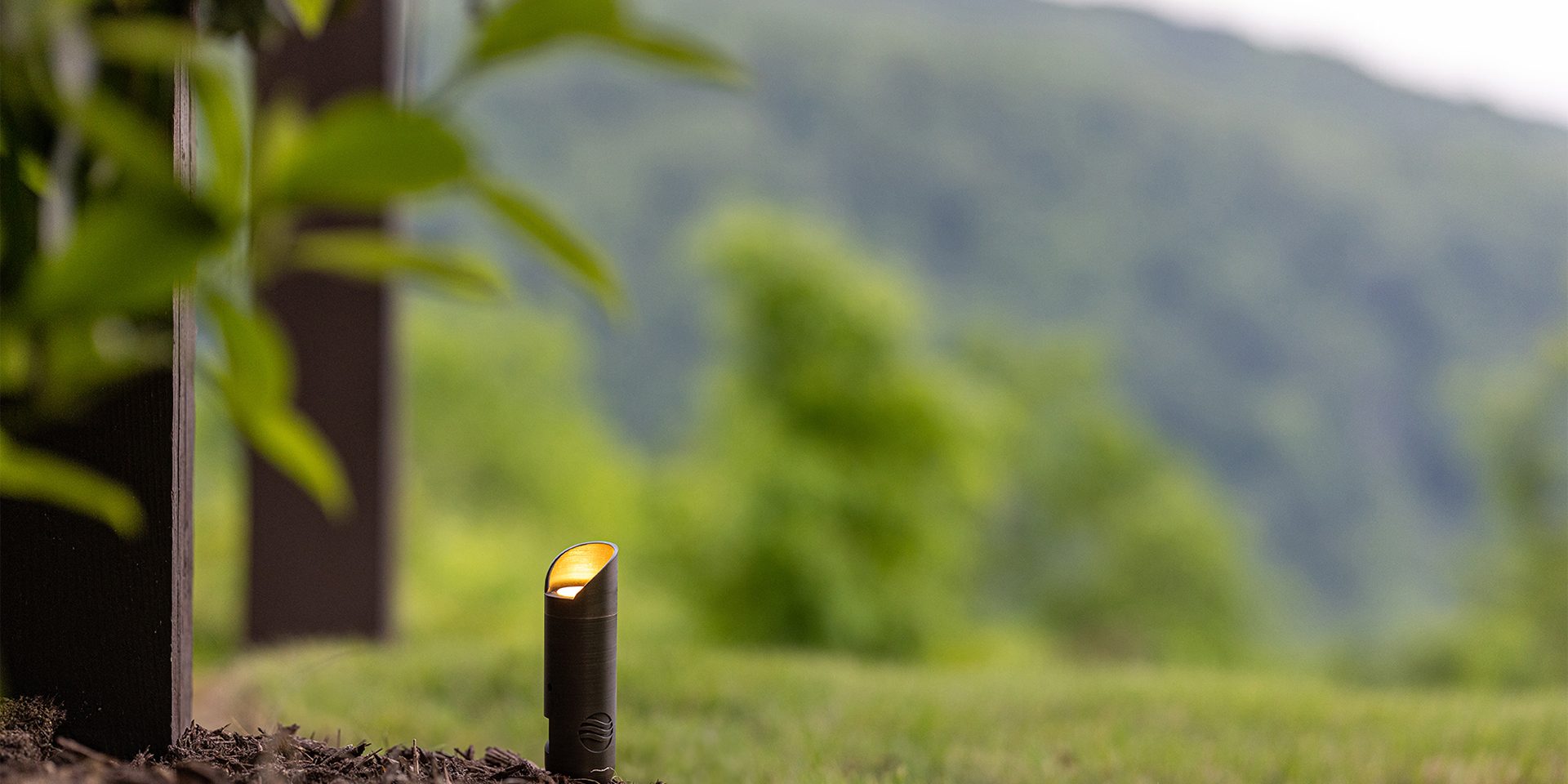
Landscape lighting runs at 12 volts through a transformer rather than at line voltage, and the difference matters in practical ways. Low-voltage systems are far safer to work around in a garden where people dig, the cable does not require the burial depth and conduit protection of line voltage, so runs can be adjusted as planting matures, and the fixtures themselves can be smaller and more discreetly placed.
Low-voltage lighting installation is named explicitly on our Pennsylvania Home Improvement Contractor registration, PA027076, alongside landscape and irrigation contracting. When we design a permanent system, we recommend and install Coastal Source, which is built around marine-grade solid brass construction and sealed connections rather than the sockets and gaskets that tend to fail after a few winters.
February Is Hard on Buried Wire
Three local conditions determine how long an installation lasts:
- Freeze-thaw. Water that enters a fixture or connection and then freezes will force it open. This is the leading cause of landscape lighting failure in the region, and it is almost always a connection problem rather than a fixture problem, which is why sealed, waterproof connections are the baseline here rather than an upgrade.
- Clay soil. Ground that holds water and heaves through winter gradually pushes fixtures out of alignment. An uplight aimed perfectly in October can be pointing at nothing by March if it was not set properly.
- Growth. A landscape is not static. A fixture placed eighteen inches from a young shrub will be inside that shrub within four years, so good design leaves room for what the planting will become, and a system worth owning can be adjusted as it does.
Pointing Light Up, and Pretending It Is the Moon
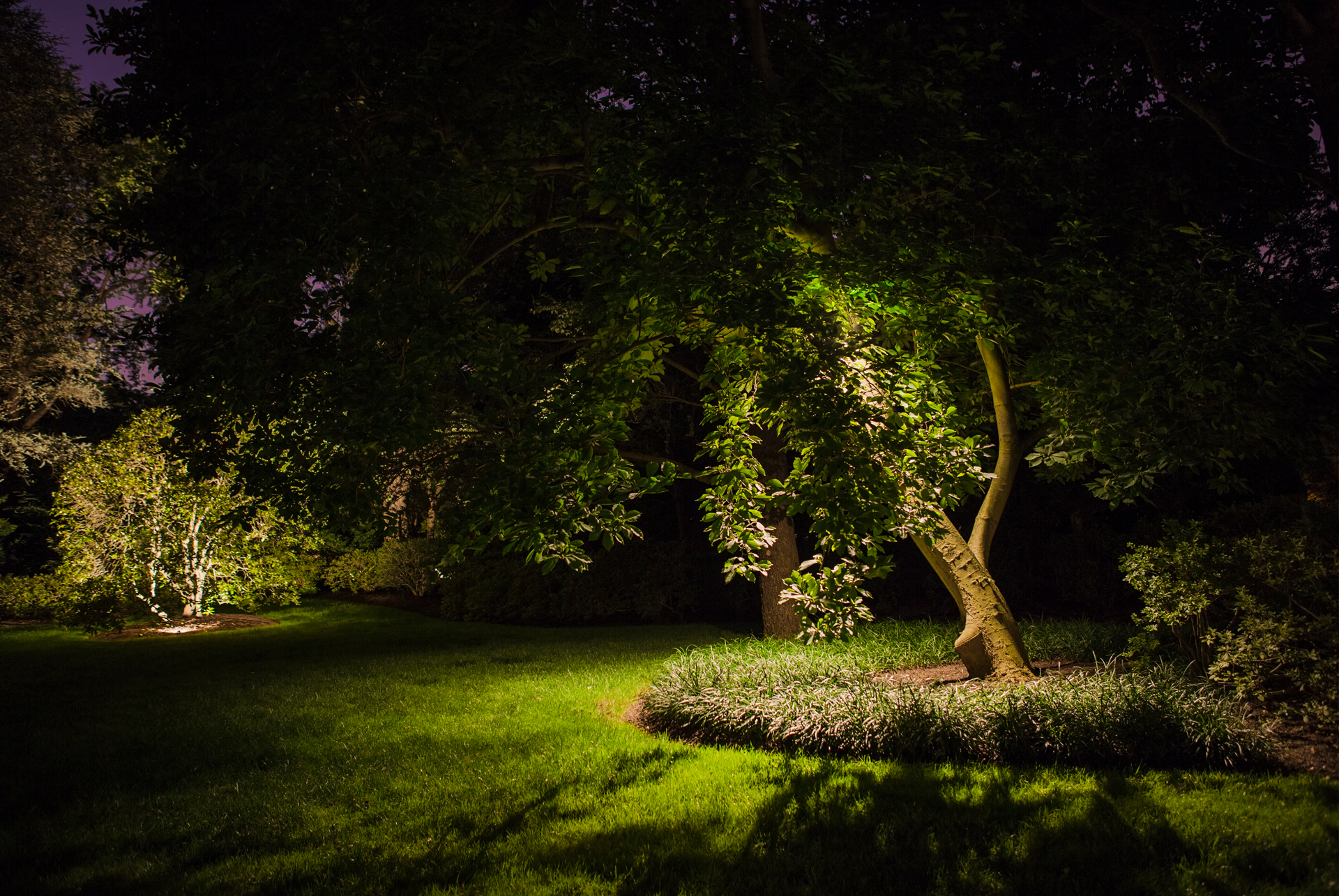
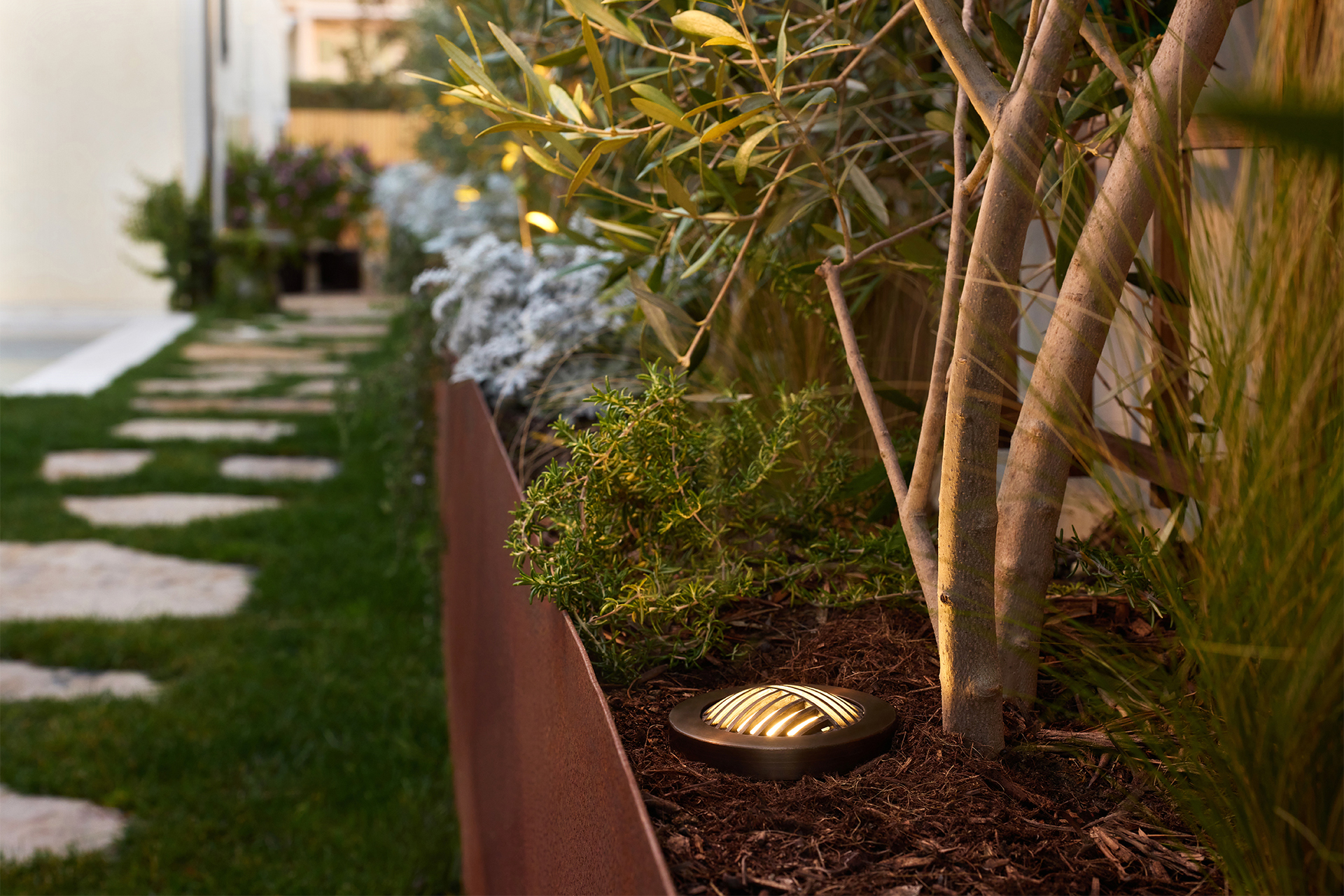
- Uplighting. A fixture at the base of a tree or wall, throwing light upward. The workhorse of architectural lighting, and the easiest technique to overdo.
- Downlighting, or moonlighting. Fixtures mounted high in a tree, casting light down through the branches to produce dappled shadow on the ground. The most natural-looking effect available.
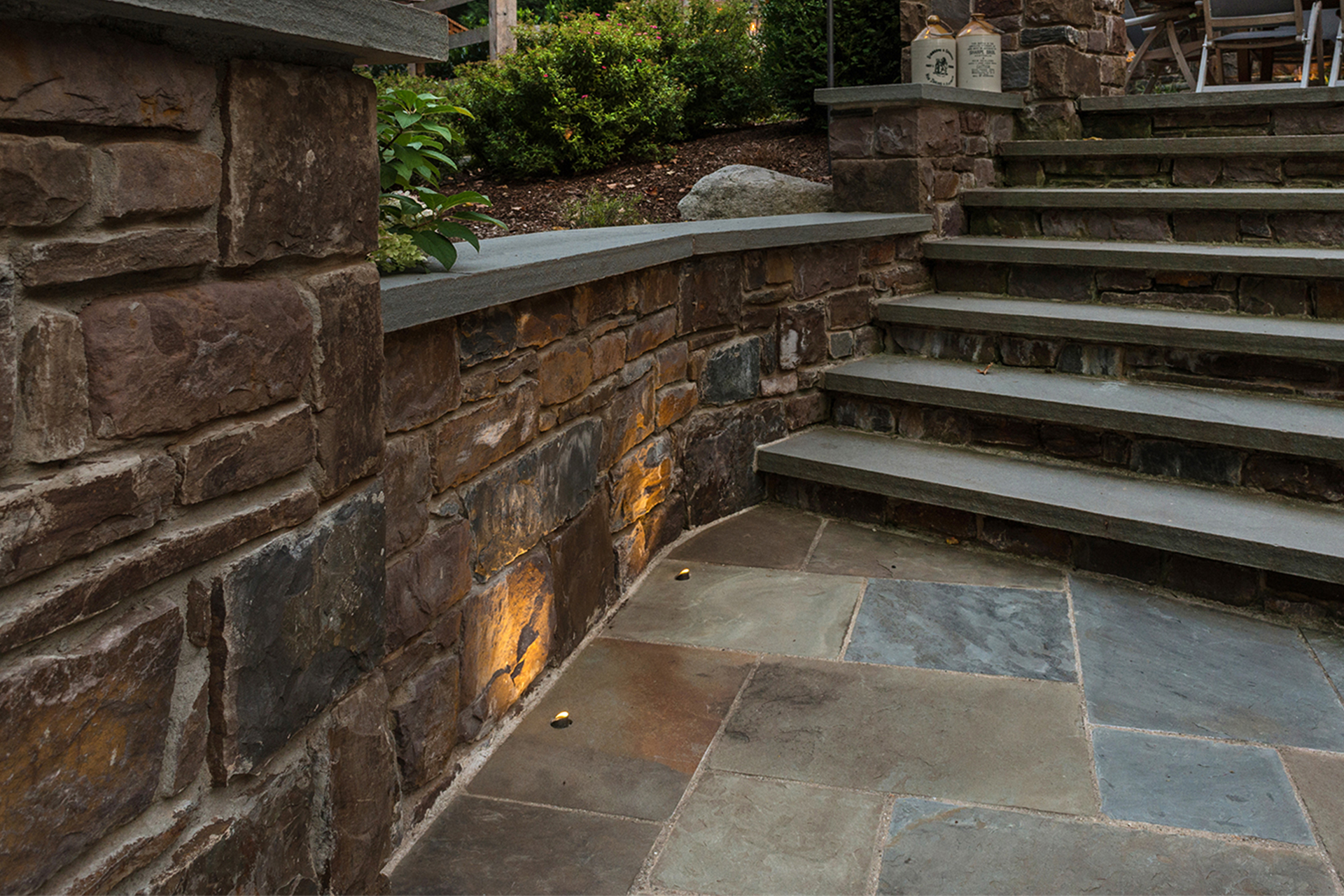
- Grazing. Light placed close to a textured surface and aimed across it. On a Bucks County fieldstone wall, grazing is what makes the stone read as stone rather than as a flat grey plane.
- Silhouetting. Lighting the surface behind an object so the object reads as a dark shape, useful for anything with a strong outline.
- Path lighting. Low fixtures washing the walking surface, best used sparingly; a path lined with evenly spaced fixtures on both sides reads as a runway.
- In-grade and well lights. Fixtures set flush into paving or lawn, invisible by day.
Warm Enough to Sit In, Aimed So You Never See the Source
Color temperature, measured in kelvin, sets the character of the entire scheme. Warmer light in the 2700K range flatters stone, brick, timber, and skin, and it is what most residential properties want. Cooler light near 4000K reads clinical outdoors and tends to leave planting looking grey.
The more consequential mistake, however, is glare. If the lamp itself is visible from anywhere you normally stand or sit, the fixture is in the wrong position or needs shielding. Well-designed lighting shows the effect and hides the source.
One Trench, Two Systems
Lighting and outdoor sound are usually installed together, because both need cable in the ground before anything is paved or planted, and both are designed around the same living spaces. Properly specified outdoor speakers deliver even, low-level coverage across a terrace rather than two loud points, which is the difference between music you can talk over and music you have to shout over.
Before You Sign Anything
- What is the plan for connections, and are they sealed against water?
- What is the transformer capacity, and is there room to expand the system later?
- What color temperature is specified, and why that choice for this property?
- Where will fixtures sit relative to the planting in five years?
- Can the aim be adjusted after installation without digging?
Talk to Us About Your Property
The Lingo Group has been working on Bucks County properties since 1982, and lighting sits within our outdoor lighting and audio service. It is usually planned alongside hardscaping and masonry and landscaping, because sleeves and cable have to go in before paving does.
We work across Bucks County, including Doylestown, Newtown, Warrington, Chalfont and Buckingham. Call (215) 343-7700, Monday to Friday, 8:00 AM to 4:00 PM, and we will walk the property with you after dark, which is the only sensible time to plan lighting.