
Pavers, Bluestone or Poured Concrete: Choosing Hardscape Materials in Bucks County
Most hardscape conversations begin with a photograph. A homeowner has seen a terrace they admire and wants something similar. The more productive conversation, though, starts a layer down, with what sits underneath the surface and what a decade of Pennsylvania winters will do to it. Around here, the material you choose matters far less for how a patio looks in its first June than for how it looks in its ninth March.
What follows is a practical comparison of the three surfaces we are asked about most often, along with the local conditions that should shape the decision.
Three Local Conditions That Decide Everything
- Freeze-thaw cycling. Southeastern Pennsylvania does not freeze once in December and stay frozen. It freezes and thaws repeatedly all winter, and every cycle gives any water trapped beneath a surface another opportunity to expand and lift it. Surfaces that tolerate movement survive this; rigid surfaces eventually crack.
- Silt loam over clay and shale. Much of the county has workable topsoil sitting on heavy clay, shale, or rock. Clay holds water and swells, while shale can stop excavation at a depth nobody planned for. Neither is a reason to avoid building, but both are reasons the base matters more than the paver.
- A frost line near three feet. Anything with a footing that must stay perfectly still through winter has to be founded below the frost line. This is why steps and seat walls cost more per square foot than an open terrace.
Concrete Pavers
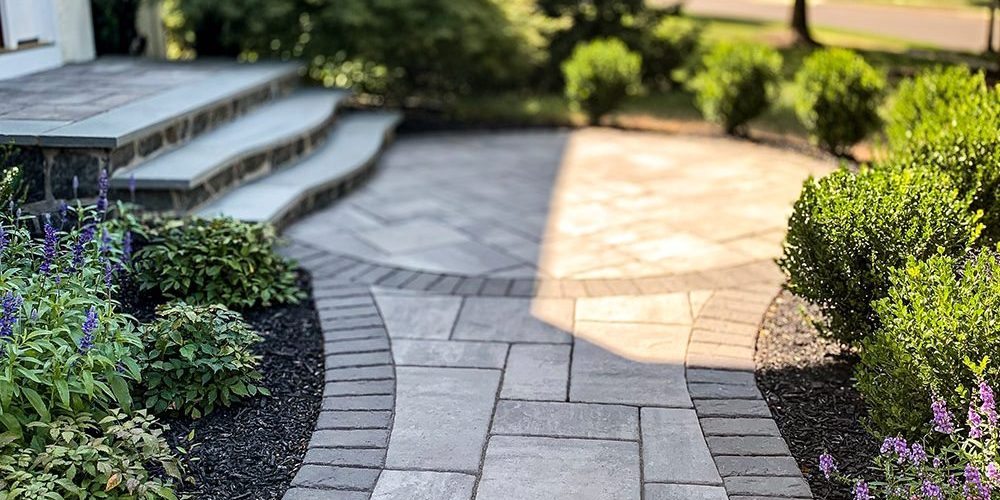
Manufactured pavers are the default choice for good reason. They are dimensionally consistent, which allows fast, tight installation and a predictable finished level, and they come in formats ranging from small tumbled cobbles to large contemporary slabs.
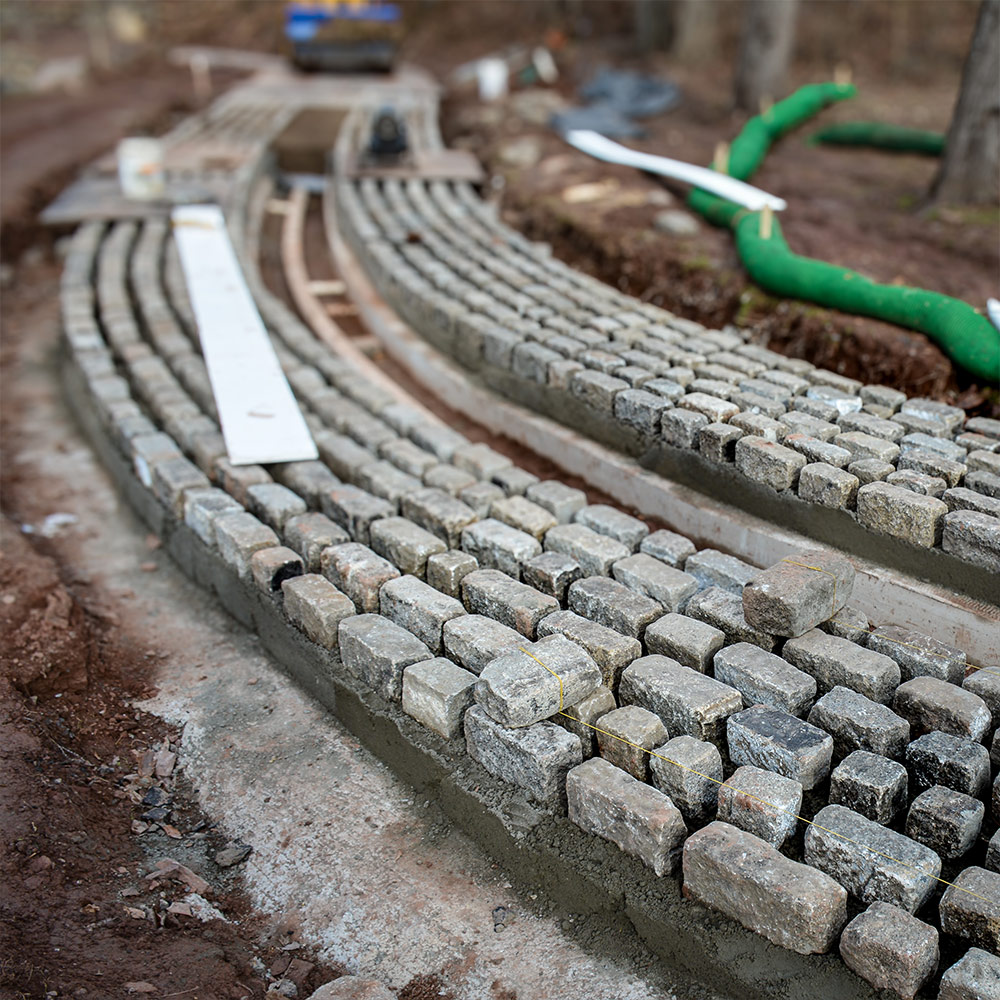
Their real advantage in this climate is structural. A paver field is a flexible system rather than a single slab; it consists of hundreds of individual units resting on compacted aggregate, so when the ground moves, the field moves with it instead of cracking. Repairs are equally forgiving. When something goes wrong beneath the surface, or a utility needs to be reached, the affected units are lifted, the base is corrected, and the same pavers are relaid with no visible trace.
The trade-off is aesthetic: pavers are a manufactured product, and at close range they read as one. On a period stone house, certain formats can look conspicuously new.
Bluestone and Natural Stone
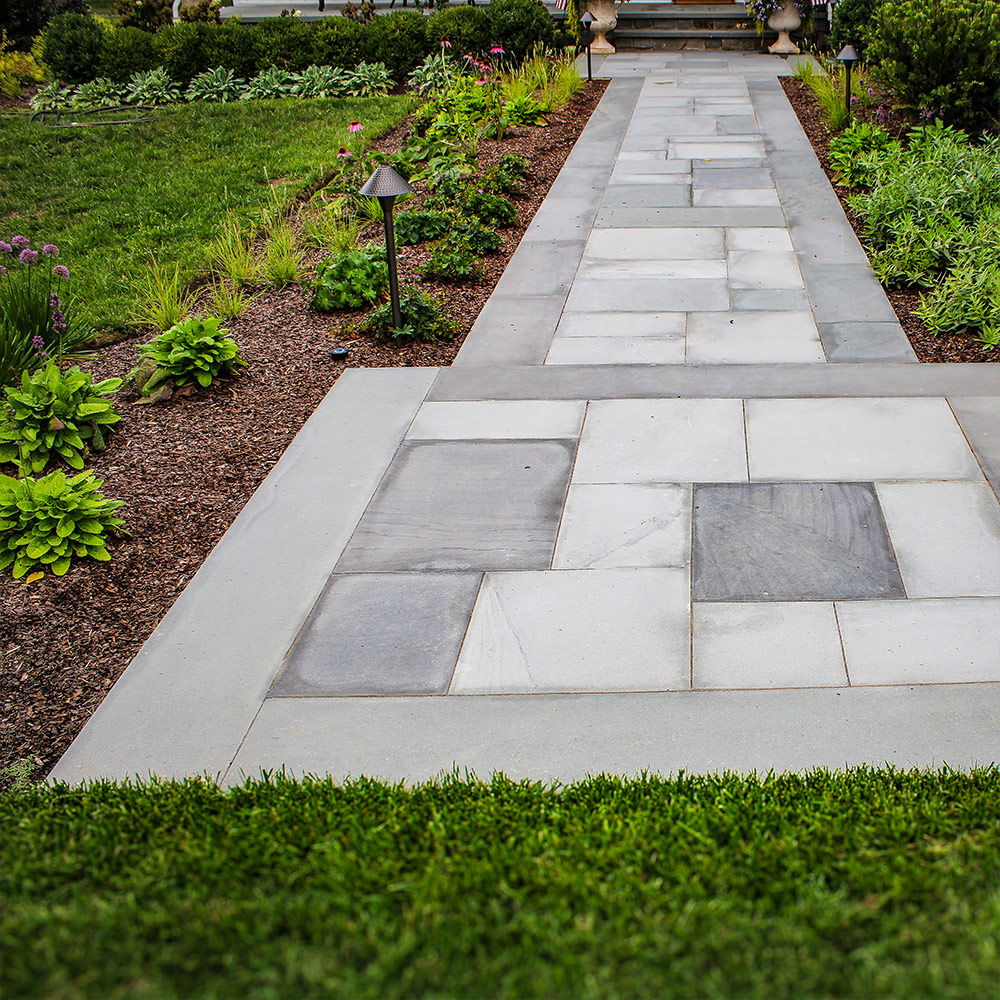
Bluestone is the regional material, the surface from which the older terraces, walks, and porch treads in this county were built. On a fieldstone farmhouse, very little else looks correct. Full-range bluestone carries blues, greys, rusts, and buffs, while select blue is more uniform and reads more formal.
A distinction that matters more than most homeowners realize is how the stone is set:
- Dry-laid stone rests on compacted aggregate like a paver field, so it flexes with the ground, and individual pieces can be lifted and reset over the years.
- Wet-laid stone is mortared onto a reinforced concrete slab, which produces tight joints and a crisp, formal surface, but converts the terrace into a rigid system whose lifespan depends entirely on the slab and the drainage beneath it.
Natural stone carries the highest up-front cost of the three. It is also the material most likely to look better in year twenty than it did in year one.
Poured Concrete
Poured concrete is the least expensive to install and the fastest to place across large open areas. Modern finishes have moved well beyond the broom-finished slab, and a well-executed pour with a sensible control-joint layout can look clean and deliberate.
Its honest limitation is that it is a rigid, monolithic surface in a climate that moves. Control joints tell concrete where to crack; they do not prevent cracking. When a crack appears or a section settles, there is no invisible repair, only patching, resurfacing, or cutting out and replacing a section, all of which show. Concrete also reacts poorly to de-icing salt, a point worth weighing for front walks and driveway aprons.
The Three Materials Side by Side
| Material | Behavior in freeze-thaw | Repairability | Relative up-front cost | Best suited to |
|---|---|---|---|---|
| Concrete pavers | Flexible field, moves with the ground | Excellent; lift and relay the same units | Middle | Most patios, walks, pool surrounds and drives |
| Bluestone, dry-laid | Flexible; individual pieces reset | Very good | Highest | Period stone houses, terraces, treads |
| Bluestone, wet-laid | Rigid; depends on the slab | Poor once the slab cracks | Highest | Formal terraces where tight joints matter |
| Poured concrete | Rigid; cracks at control joints | Poor; repairs are visible | Lowest up front | Large open areas, utility surfaces, budget-led work |
What Actually Drives the Cost
We deliberately avoid publishing per-square-foot figures, because on real properties the surface material is rarely the largest line item. Five site factors usually are:
- Access. Whether a machine can reach the work area, or whether every ton of aggregate and every pallet of stone moves through a side gate by hand. On a Doylestown borough lot, this single factor can outweigh the material choice.
- Grade. Flat sites are economical. Sloped sites require retaining, steps, or both, and steps are the most labor-intensive element in any hardscape.
- Base depth. Clay subgrade demands more excavation and more stone than sandy ground, and a driveway needs considerably more than a patio.
- Drainage. Water must have somewhere to go. Most hardscape failures we are called to assess are drainage failures wearing a paving costume.
- Detail. Curves, banding, inlays, seat walls, steps, lighting, and edge restraint are where the labor hours accumulate.
Two patios of identical square footage on properties a mile apart can differ substantially on those five points alone, which is why a site walk precedes any number we put on paper.
Matching the Material to the House
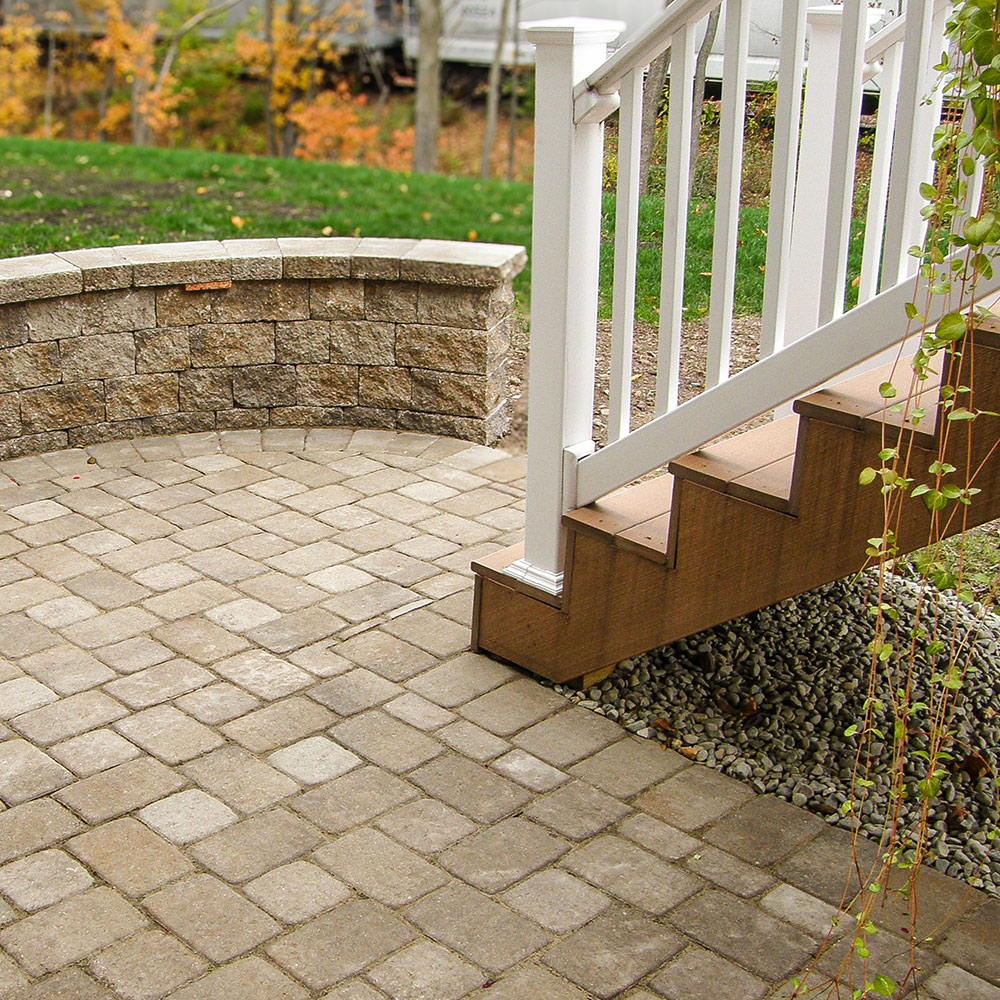
Bucks County holds an unusually wide range of housing stock for a single county, and a material that flatters one house can undermine another. On an eighteenth or nineteenth century fieldstone farmhouse, bluestone and reclaimed stone nearly always sit better than a manufactured paver, because they are the materials the house was built alongside. On a newer colonial in a township development, a good large-format paver typically reads cleaner and more current than an attempt at rustic stone. On a contemporary build, large slabs with tight joints and minimal banding are usually the stronger choice.
The other half of the equation is what the new work must meet. A terrace that has to marry into an existing bluestone walk, pool coping, or stone wall has fewer honest options than a blank site.
Questions Worth Asking Before You Sign
- How deep is the base going, and what is it made of?
- What is the plan for water, both surface runoff and what collects beneath the base?
- Are steps and walls founded below the frost line?
- Is the stone dry-laid or wet-laid, and why that choice on this site?
- Who performs the work, an in-house crew or a subcontractor?
- What happens if a section settles in year three?
A contractor who answers those six questions clearly is telling you more about the finished result than any photograph can.
Talk to Us About Your Project
The Lingo Group has been working on Bucks County properties since 1982, and our hardscaping and masonry crews build patios, terraces, walkways, steps, retaining walls, and pool surrounds across the county. You can see finished work in our project galleries, or read about how we approach landscaping in Doylestown and the surrounding townships.
Call (215) 343-7700, Monday to Friday, 8:00 AM to 4:00 PM, and we will walk the site with you.