

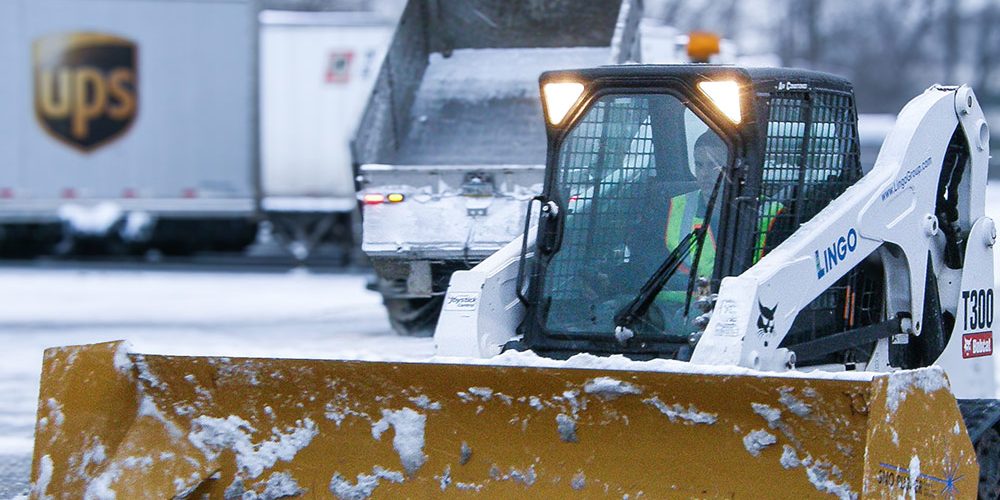
ADA parking snow removal in Bucks County fails in the same six feet every winter. The lot gets plowed, the lanes open up, and then the striped access aisle beside the accessible space vanishes under the windrow the plow pushed there. By eight in the morning a patient in a wheelchair cannot get out of a van at the Doylestown medical office you manage, and the property is out of compliance even though the lot looks clear from the road.
The Eight Feet Between the Space and the Door
An accessible parking space is really two pieces of pavement. There is the stall, and there is the marked access aisle beside it, which is where a side-mounted lift sets a wheelchair down. Federal standards set that aisle at a minimum of 60 inches for cars and 96 inches for van-accessible spaces, and the aisle has to connect to a route that reaches the door. You can read the dimensions on the Department of Justice parking page. Snow pays no attention to any of it. Most plows throw to the right, the aisle usually sits to the right of the space, and the one strip of pavement that has to stay open becomes the easiest place to stack slush.
The curb ramp is the second failure point. Ramps at the head of the route catch whatever gets pushed toward the island, and then that pile refreezes overnight into a ridge nobody can roll over. Clearing the lot around those two features is not the same as clearing them.
The Bucks County Lots Where ADA Parking Snow Removal Falls Apart
Older strip centers are the worst offenders, because the accessible spaces were striped into a lot that was never designed around them. Along the Route 611 corridor through Warrington and Willow Grove you will find rows where the aisle sits directly against a curbed island, so a plow has nowhere to go but over it. Professional buildings in Doylestown have the opposite problem. The accessible spaces sit closest to the entrance, which is also the most convenient corner for a pile, so they get buried first and dug out last.
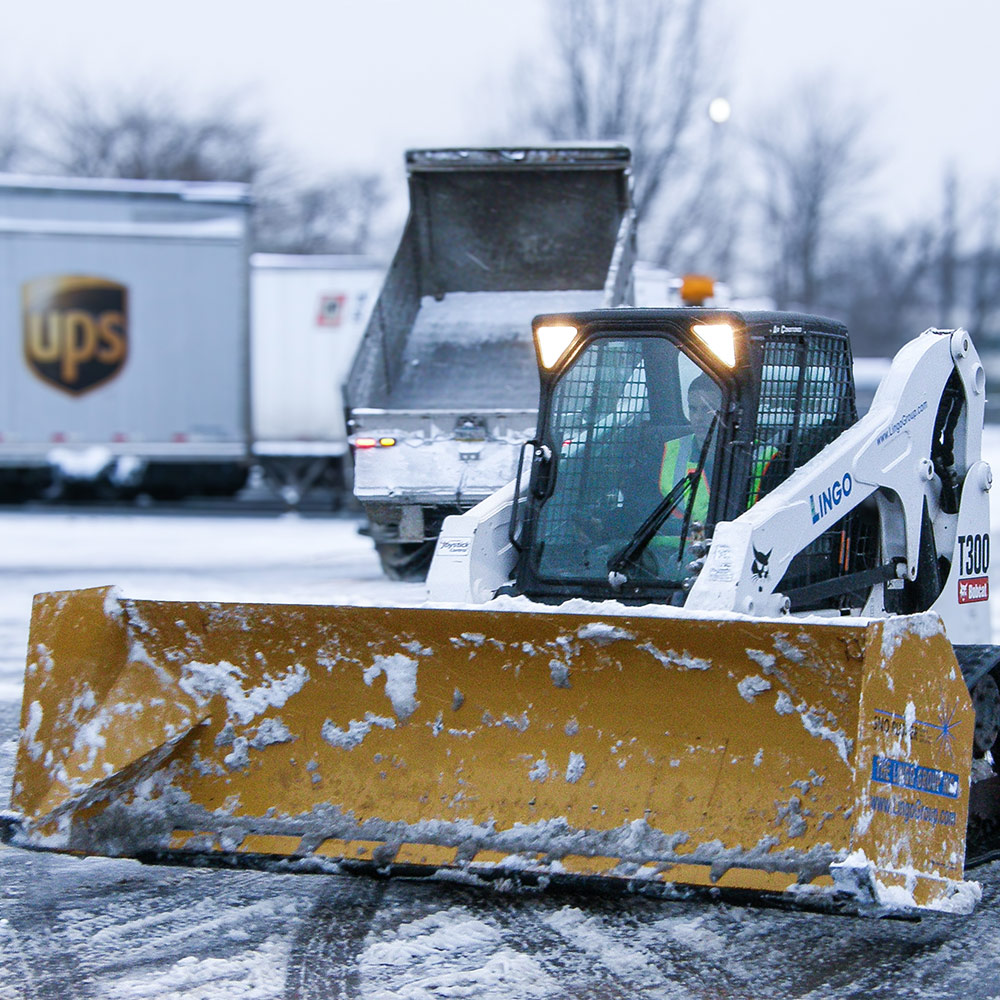
Churches, municipal buildings and HOA clubhouses run into a third version of it. Nobody is on site at 5 a.m. to notice the aisle is gone, so the first person to find out is the resident who needs it. If your site has the same pinch points on its walkways, our piece on sidewalk snow removal in Bucks County covers the pedestrian side of the same problem, and medical office snow removal gets into appointment-time sequencing.
A Half Inch on the Ramp, Two Inches on the Lot
Trigger depth is the accumulation that has to fall before crews roll. Running one number across a whole property is where most of the trouble starts. We build commercial contracts with a split trigger, and the numbers are published on our snow management page. Walkways and ADA ramps sit at 0.5 to 1.0 inch for liability reasons. The open lot sits at 1.5 to 2.0 inches, because dispatching a fleet for an inch of powder on a warehouse apron burns money for nothing. High-traffic retail and medical sites run at 1.0 inch, and zero-tolerance properties move on a trace of ice.
Put plainly, the accessible route gets serviced sooner and more often than the rest of the lot. That is the whole point of splitting it. A single 2-inch trigger across the site technically satisfies the contract while leaving the access aisle unusable for most of the storm.
Meltwater Finds the Lowest Point
Bucks County rarely gives you one clean storm and a thaw. We get freeze-thaw cycles, and the National Weather Service office in Mount Holly tends to put the overnight low below freezing for days after the snow stops. Here is what that does to a parking lot. Piles stacked uphill of the accessible spaces melt through the afternoon, the water runs across the aisle, and at dusk it turns into a sheet of ice sitting exactly where a wheelchair has to go.
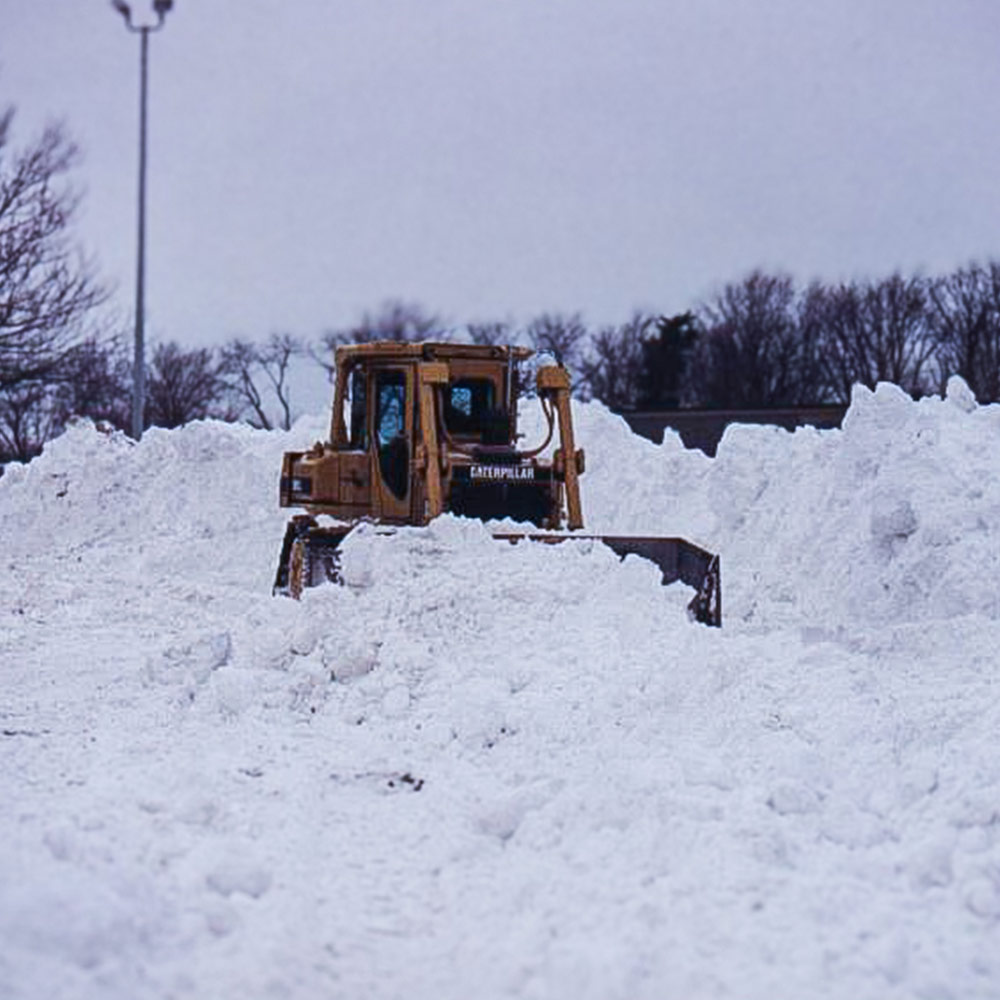
So pile placement is a design decision, not a convenience. Snow goes downhill of the accessible route or it goes off the property. On tight sites with nowhere to stack, loading and hauling is the only honest answer, and we price it that way. De-icing and anti-icing treatment on the aisle and the ramp handles what plowing cannot reach.
What the Rulebook Says About a Plowed-In Space
Townships, school districts and other public entities fall under Title II, which requires that accessible features be kept in working condition. The text lives in 28 CFR 35.133, and federal guidance has long treated snow on accessible spaces and access aisles as something to be cleared promptly rather than whenever the rest of the lot gets done. Private businesses carry a parallel obligation under Title III.
We are not attorneys and this is not legal advice, so talk to yours about your specific exposure. But the practical standard is easy to remember. If you are clearing the lot, the accessible spaces, their aisles and the curb ramps get cleared in the same visit, not the next one.
Writing It Into the Contract Before the First Storm
Most snow contracts describe the lot in square footage and the walkways in linear footage. Accessible spaces fall between the two, which is how they end up belonging to nobody. Ask for three things in writing. First, name the accessible spaces, access aisles and curb ramps as their own line item with their own trigger depth. Second, state where snow may be stacked and where it may not, by location on the site plan. Third, confirm who treats the aisle for ice and how often during a multi-day event.
Billing follows the same logic it does everywhere else. A seasonal contract fixes your winter number regardless of snowfall, while per-event billing costs less in a mild year and more in a hard one. Neither one changes what the crew is obligated to clear, as long as the scope is written down.
The Lingo Takeaway
ADA parking snow removal in Bucks County is a scope problem before it is a weather problem. The equipment to clear an access aisle is not exotic and the time it takes is measured in minutes. What goes wrong is that nobody wrote down who owns those minutes. We work out of Chalfont, our crews run central and lower Bucks every storm, and we would rather settle the aisle, the ramp and the pile locations during a site walk in November than argue about them in February.
Common questions
Does the access aisle have to be cleared at the same time as the parking space?
Treat it as one unit. An accessible space with a buried aisle is not usable, so clearing the stall alone accomplishes nothing for the person who needs it.
Can we stack snow in an accessible space if the lot is full?
No. Pick a stacking area at the time of the site walk, keep it downhill of the accessible route, and haul the excess off site once the area fills.
What trigger depth should accessible spaces run at?
We set ADA ramps and walkways at 0.5 to 1.0 inch while the open lot runs at 1.5 to 2.0 inches. The accessible route gets serviced earlier in the storm.
Who is responsible, the property owner or the tenant?
That depends on your lease. Read the common area maintenance language, then make sure the snow contract matches it, because a gap between the two documents is where claims start.
Does any of this apply to a residential driveway?
Our snow work is commercial. We handle parking lots, access roads, walkways and HOA properties rather than individual driveways.
By town
Commercial snow routes are built before the season, and boards and facility teams set budgets in the fall. Here is where we cover.
- Commercial snow removal in Doylestown, PA
- Commercial snow removal in Warrington, PA
- Commercial snow removal in Chalfont, PA
- Commercial snow removal in Newtown, PA
- Commercial snow removal in Buckingham, PA
If you want the accessible spaces on your property written into the scope this season, call the office at (215) 343-7700 or reach us through the contact page and we will walk the site with you.