
Commercial Snow Removal in Bucks County, PA
September 12th, 2026
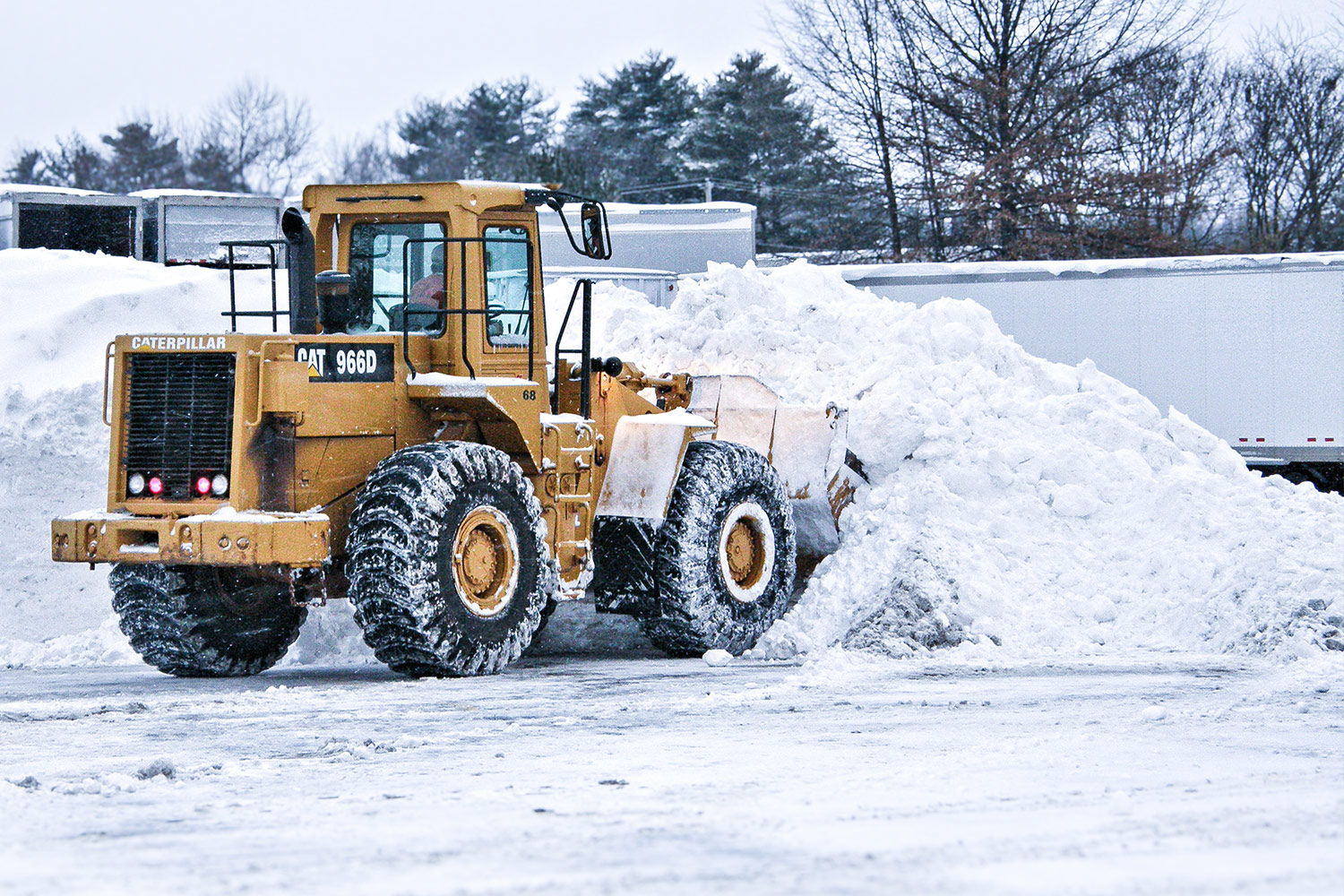
If you manage a large commercial property in Bucks County, your snow plan is a liability plan first and a convenience second. A shopping center off Route 611, an office park in Warrington, a medical building near Doylestown Health, a distribution facility in Falls Township. They all share the same problem. The moment snow starts falling, you are responsible for whether people can safely walk and drive across your property.
We’ve been handling commercial snow and ice management across Bucks County since 1982. Here’s what large property owners and managers should have locked down before the first storm.
The kind of site we built this operation around
We built our snow operation around properties that need more than a pickup with a plow. If your site has any of the following, you’re in the right place.
- Parking areas of roughly an acre or more, or 50-plus spaces
- Multiple entrances, loading docks, or drive aisles that have to stay open
- Tenants, patients, customers, or employees arriving on a schedule you don’t control
- A lease or association agreement that puts snow duty on you in writing
- Sidewalks, crosswalks, and ADA access routes connecting buildings to parking
Office parks, retail centers, industrial and warehouse sites, medical campuses, senior living communities, schools, churches, and municipal facilities all fit. Single-family driveways sit outside what we’re built for, so every truck and every operator we have is pointed at properties like yours.
The Bucks County winter you’re actually planning for
Doylestown averages about 28 inches of snow a year across a season that runs roughly from mid-November to early April. That average hides the part that matters. Some winters deliver it in six manageable events. Others drop half of it in one weekend and then ice over for a week.
| Month | Average snowfall | What it usually means for your site |
|---|---|---|
| November | 1.1 inches | First dusting, pre-treat and system check |
| December | 4.7 inches | First real plowable events, holiday retail traffic |
| January | 8.1 inches | Peak volume, repeat events, salt demand climbs |
| February | 9.0 inches | Snowiest month, heaviest pile management |
| March | 4.9 inches | Wet heavy snow, melt and refreeze cycles |
| April | 0.5 inches | Tail end, ice risk on shaded pavement |
The melt and refreeze cycle is the one that catches Bucks County properties out. We sit right around the freezing line for a lot of the winter. Pavement that’s wet and safe at 3 pm is a sheet of black ice at 7 pm. That’s an ice management problem, not a plowing problem, and it’s where most of the injury claims come from.
Ten hours, full width, bare pavement
Snow rules in Bucks County are set township by township and borough by borough, so the deadline on your site depends on where you sit. Doylestown Borough is one of the stricter ones and it’s a useful benchmark.
In the borough, property owners have 10 hours after snowfall stops to clear sidewalks. If snow falls overnight, walks need to be clear by 10 am. Sidewalks have to be cleared to their full width, down to bare pavement, not a shoveled footpath through the middle. Pushing your snow into the street is against the ordinance and can be fined. When the mayor declares a snow emergency, parking is restricted on designated roads and vehicles get ticketed and towed.
Township deadlines vary, and if your property spans a borough line or fronts a state road, you can be working under two sets of rules at once. We map that out per site before the season so nobody’s guessing at 5 am.
Hills and ridges, and the two ways you lose it
Pennsylvania uses what’s called the hills and ridges doctrine. In plain terms, you are not expected to keep your pavement bare at every moment during an active storm. If conditions are generally slippery because it’s snowing, that alone usually isn’t enough for someone to win a claim against you.
To win, an injured person generally has to show three things. That snow or ice built up into ridges or elevated formations that unreasonably blocked safe travel. That you knew or should have known about it. And that it caused the fall.
Here’s the part commercial owners tend to miss. You lose that protection in two situations. The first is an isolated patch of ice on otherwise clear pavement, because a single patch isn’t a general condition and you could reasonably have dealt with it. The second is bigger: you lose protection when the ice was created by something artificial rather than by nature.
That second one is a direct consequence of how your property gets plowed. If snow gets piled uphill of a walkway or at the top of a sloped lot, it melts during the day, runs across the pavement, and refreezes overnight. That ice is not natural accumulation. It’s a condition your snow contractor created. Same goes for piles stacked over storm drains, or against downspouts, or in the middle of a pedestrian route.
Where we stack snow on your site is a liability decision, not a convenience decision. We plan pile locations around drainage and grade before the season starts, and we mark them on a site plan you keep. If the piles on your property right now are simply going wherever the lot is emptiest, walk the site with us and we’ll show you what that costs you in March.
Four ways to buy a winter
There’s no single right answer here. It depends on your budget process and how much variability you can absorb.
| Structure | How it works | Best fit |
|---|---|---|
| Per event | You’re billed for each push and each application | Sites with flexible budgets that want to pay for actual work |
| Seasonal fixed | One price for the whole season regardless of snowfall | Associations and tenants who need a fixed line item |
| Time and materials | Billed on hours on site plus material used | Complex sites where scope shifts storm to storm |
| Hybrid | Seasonal base for service, materials billed as used | Large sites wanting predictable service with honest salt cost |
Whatever structure you pick, the contract should name your trigger depth, your priority sequence, your response window, and who’s responsible for sidewalks versus pavement. If those four things aren’t in writing, you don’t have a snow contract. You have a phone number and some optimism.
Everything inside a short run from Timber Lane
We run commercial snow and ice management out of our Chalfont yard on Timber Lane, which puts most of central and upper Bucks inside a short response window. We regularly service properties in Doylestown, Chalfont, Warrington, Newtown, and Buckingham, plus New Britain, Warminster, Perkasie, Sellersville, Hatfield, Horsham, and the surrounding townships.
The Lingo Takeaway
Commercial snow removal in Bucks County isn’t about who can push snow. Plenty of outfits can push snow. It’s about whether your provider understands your grade, your drainage, your pedestrian routes, and the ordinance you’re operating under, and whether they’ve thought about where the meltwater goes at 4 pm on a sunny February afternoon. That’s the difference between a cleared lot and a cleared lot that doesn’t generate a claim.
Common questions
How early should we lock in a snow contract?
Late summer through early fall. We build routes around committed properties, and once a route is full, it’s full. By the time the forecast shows the first storm, the good contractors in Bucks County are already booked.
What’s a trigger depth and what should ours be?
It’s the accumulation that starts your service automatically without anyone calling us. Two inches is common for commercial lots. Medical facilities, senior living, and anywhere with heavy foot traffic often go to one inch or zero tolerance. We’ve written more about how trigger depth works.
Do you handle sidewalks and walkways, or just the parking lot?
Both, and you want both from the same provider. Split them between two contractors and you get a plow pile blocking the walk somebody else just cleared. Most of the coordination failures we get called in to fix start there.
What happens if it ices over but never really snows?
That’s a normal Bucks County winter week and it’s covered. Anti-icing before the event and deicing after are part of the scope. Some of our busiest nights involve no plowing at all.
Can you handle multiple properties under one agreement?
Yes. If you manage a portfolio across Bucks County, we’d rather put it on one agreement with one point of contact and one billing cycle than run five separate conversations during a storm.
This season’s routes are filling now
We’re building this season’s commercial routes now. If you manage a large property or a portfolio in Bucks County, call us at (215) 343-7700 or use our contact form and we’ll walk your site, map your piles and priorities, and put a real scope in front of you.
Learn more about our snow and ice management services, or see everything included in our commercial plowing.
By town
We price and route commercial snow work town by town. See commercial snow removal in Doylestown, Warrington, Chalfont, Newtown and Buckingham.