
Parking Lot Snow Removal in Bucks County, PA
September 12th, 2026
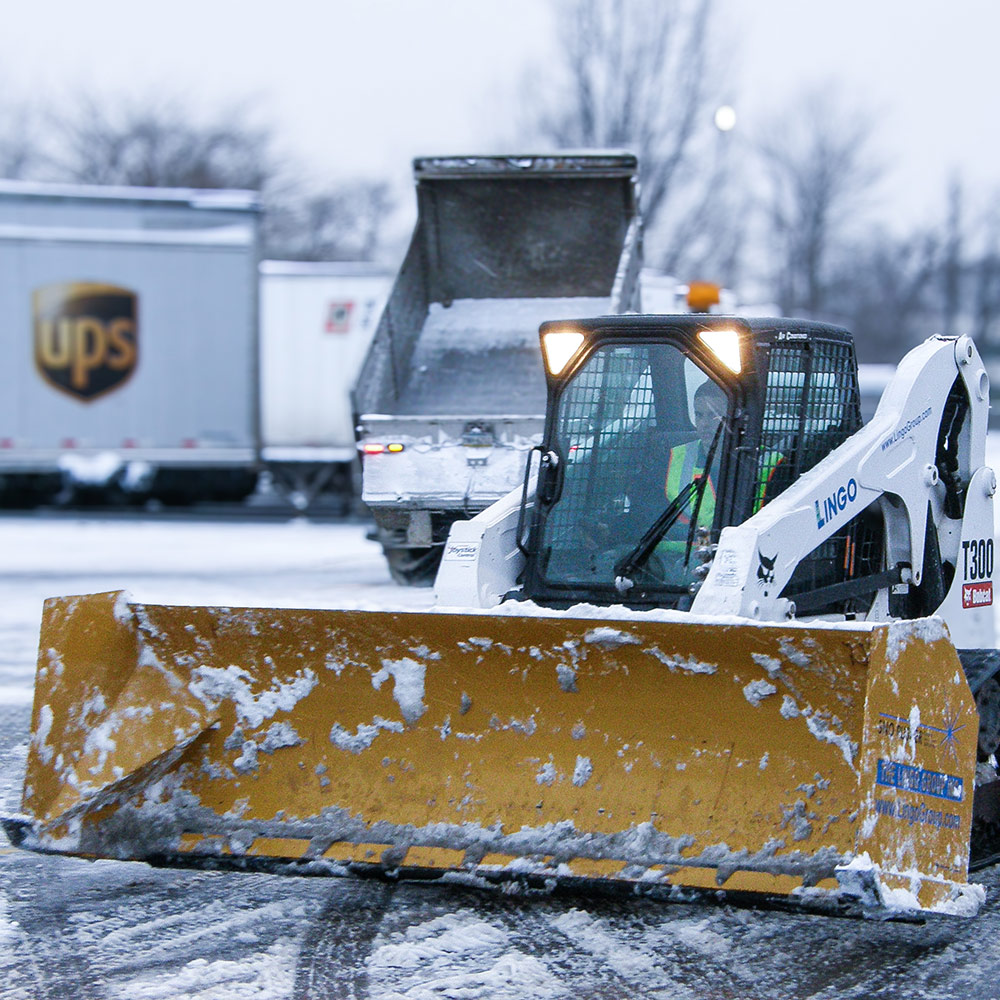
A parking lot is the hardest part of any commercial property to clear well, and it’s the part where things go wrong most expensively. Not because pushing snow is complicated, but because a lot has grade, drainage, islands, curbs, lighting bases, irrigation heads, fire lanes, ADA routes, and tenants who all think their entrance should be first.
If you manage retail centers, office parks, medical buildings, or industrial sites in Bucks County, this is what separates a lot that gets plowed from a lot that gets managed.
The order is set in October, not at 4 am
The order we clear your lot is set before the season, not during the storm. On most commercial sites in Bucks County the sequence looks like this.
- Fire lanes and emergency access, always first
- Main entrances and exits onto the public road
- Primary drive aisles so traffic can circulate
- ADA spaces and the access aisles connecting them to the door
- Loading docks and service areas, timed around delivery windows
- General parking, worked outward from the building
- Sidewalks and crosswalks, coordinated so plow piles don’t undo the work
- Cleanup pass, pile shaping, and deicing
That sequence changes by property type. A medical building near Doylestown Health needs patient drop-off open before general parking. A distribution site in Falls Township needs dock doors open before the employee lot. A retail center on Street Road needs the customer entrance clear before the back of the lot. We set that with you in the fall, so at 4 am nobody’s making it up.
The empty corner is rarely the right corner
Stacking is the single most consequential decision on a commercial lot, and it’s the one most contractors make by convenience. The empty corner is not automatically the right corner.
Piles need to sit downhill of pedestrian routes, away from storm drains, clear of sight lines at exits, and off the landscape beds you paid to install. Get it wrong and you create three problems at once. Meltwater runs across walkways and refreezes overnight. Drains back up and the lot floods on the thaw. And the pile kills the turf and shrubs underneath it, which shows up as a spring replacement invoice.
There’s also a liability dimension. Pennsylvania’s hills and ridges doctrine gives property owners real protection against claims from naturally slippery conditions. That protection goes away when the ice came from an artificial condition instead of from nature. A plow pile placed uphill of a sidewalk, melting each afternoon and refreezing each night, is about as clear an example of an artificial condition as you’ll find. Where your contractor stacks snow is a risk decision.
On large sites we’ll also plan for relocation and haul-off. Bucks County can hand you three storms in ten days, and a lot that had room for the first pile has no room for the third. If you’re losing 40 spaces to snow storage by mid-February, that needs to be in the plan before December.
We know what’s buried out there because we installed it
This is where being a landscape company first actually matters. We install the irrigation, the beds, the lighting, and the hardscape on a lot of the properties we plow, so we know what’s buried out there.
| What gets damaged | How it happens | How we avoid it |
|---|---|---|
| Irrigation heads | Blade catches heads along island edges and turf strips | Heads mapped and staked before first snow |
| Curbs and islands | Operator can’t see the edge under accumulation | Site staked in fall, same crews on the same properties |
| Landscape beds and shrubs | Piles stacked on plantings, salt runoff into root zones | Pile zones assigned off-bed, salt-tolerant planting where piles are unavoidable |
| Lighting bases and bollards | Struck during low-visibility pushes | Staked and included in the site map |
| Pavement and sealcoat | Blade set too low, aggressive deicer use | Shoes set for the surface, material matched to pavement age |
Staking a site in November takes a morning. Replacing a season’s worth of irrigation heads and sheared curb costs considerably more than that, and it lands in your spring budget when you’d rather be spending on something visible.
Clear at 3 pm, black ice at 7
Doylestown averages around 28 inches of snow a year, but the number that should shape your plan is how much of the winter we spend hovering right at freezing. Daytime sun melts snow off piles and roofs, water runs across the lot, and it locks up after dark.
That’s why anti-icing matters. Treating pavement before an event stops the bond between ice and asphalt from forming, which means the plow actually clears to the surface instead of polishing a layer smooth. It generally takes less material than fighting ice after it’s set, and it’s the difference between a lot that looks clear and a lot that is clear.
Material choice depends on pavement temperature, not air temperature. Rock salt stops working as pavement drops into the teens. Below that you need treated salt or a liquid blend. A contractor spreading the same material at 28 degrees and 12 degrees is wasting your money at one end and leaving you slick at the other.
Seven lines worth arguing over before you sign
For a parking lot, get these in writing before you sign.
- Trigger depth. The accumulation that starts service without a phone call. Two inches is typical, one inch or zero tolerance for medical and senior living.
- Response window. How long after trigger until equipment is on site, and whether that holds during a multi-day event.
- Priority map. The actual sequence for your property, agreed in advance.
- Pile locations. Marked on a site plan, not decided by the operator at 4 am.
- Sidewalk scope. Who clears walks, and how that’s coordinated with plowing.
- Deicing terms. When material goes down, what material, and how it’s billed.
- Documentation. Time on site, work performed, material applied, per event.
That last one is worth more than people expect. If someone files a claim against your property in March over a January fall, service records showing exactly when your crew was on site and what they applied are the strongest thing you can hand your insurer.
Short runs from the Chalfont yard
We run parking lot snow service for retail centers, office and business parks, industrial and warehouse sites, medical and dental buildings, senior living communities, schools, and churches throughout Doylestown, Warrington, Chalfont, Newtown, and Buckingham, along with New Britain, Warminster, Perkasie, Hatfield, and the surrounding townships. Our yard is in Chalfont, which keeps response times short across central and upper Bucks.
The Lingo Takeaway
Anybody can clear the middle of a parking lot. What costs you money is the edges: the pile in the wrong place, the sheared irrigation head, the walkway that ices over every night because meltwater has nowhere else to go. A parking lot is a drainage system with parking spaces painted on it, and it should be plowed by somebody who thinks about it that way.
Common questions
How long after it stops snowing will our lot be clear?
It depends on your trigger and your place in the route, which we set with you in the fall. During long events we work sites in cycles so nothing gets buried while we wait for the storm to end. You’ll know your window before the season starts, not during it.
Can you work around our business hours?
Yes, and we’d rather. Retail wants the lot clear before opening. Offices want it done before the 7 am arrivals. Warehouses want docks open for the first trucks. Tell us your schedule and we’ll build the route around it.
What happens when we run out of room for snow piles?
We relocate and, if needed, haul off site. On properties where that’s likely we price it into the plan up front so it isn’t a surprise mid-February conversation.
Who’s responsible if someone falls in our lot?
The work we do is what decides how that conversation goes. We stack snow where it won’t refreeze across a walkway, we treat before the bond forms rather than chasing ice afterward, and we log time on site and material applied for every event. When a claim surfaces in March, that record is the strongest thing you can put in front of your insurer, and properties we run produce it automatically.
Do you plow residential driveways?
No. Our equipment, crews, and routes are built entirely around commercial properties and large sites, which is why the sites we do run get the attention they need.
Routes are built around committed sites
We stake and map commercial properties in the fall and build routes around committed sites. If you manage a parking lot in Bucks County, call (215) 343-7700 or fill out our contact form and we’ll walk the property, mark your piles and priorities, and give you a scope you can actually hold us to.
More on our snow and ice management services and whether you need full ice management.
By town
We price and route commercial snow work town by town. See commercial snow removal in Doylestown, Warrington, Chalfont, Newtown and Buckingham.