

Warehouse snow removal in Bucks County looks easy from the road. One wide lot, long aisles, acres of open pavement. Then you walk a dock apron in February, and warehouse snow removal in Bucks County comes down to the hundred feet of pavement at every door.
We work out of 1170 Timber Lane in Chalfont, and The Lingo Group has been on Bucks County properties since 1982. Industrial parks sit on the list of commercial properties we handle snow and ice for, alongside retail centers, medical offices and HOAs. Distribution buildings behave differently from a shopping center, so here is how we read one before the season.
Where the Buildings Actually Sit
The county’s industrial pavement clusters along a few corridors. Route 309 carries the Hatfield and Lansdale buildings. Route 611 and Easton Road pick up Horsham and the New Britain Township sites near Doylestown Airport. Warminster keeps its business park buildings off Jacksonville Road and Bristol Road, and Montgomeryville adds more at the Route 202 split.
Each corridor hands you a different problem. A 309 building usually has room to stack snow, but its long entrance drive drifts. A Warminster business park lot often shares a drive aisle with the building next door, so that boundary is worth settling in October. Meanwhile the older pads near Doylestown sit on shale-derived clay that drains slowly, and meltwater pools instead of running off.
Grade matters more here than anywhere else on the site. Truck courts are pitched toward the dock pits on purpose, because that is how rainwater leaves the building. In winter the same pitch walks snowmelt into the pit, where it sits below grade and freezes overnight.
A Hundred Feet of Concrete at Every Door
A plow pattern built for a retail lot will not clear a dock apron. An apron is a tight rectangle with a concrete lip, a steel bumper and no room to carry a windrow past the end. Push too far and you pack snow against the dock face. Push too short and a ridge sits where a trailer needs to back square.
Trailer courts add another layer. Loaded trailers rarely move on your schedule, so half the court can stay occupied through a whole storm. The stacking plan therefore has to work with spots full, and the crew needs to know which rows your dispatcher keeps open.
Then come the details that disappear under eight inches of snow. Bollards, drain inlets, trench drains, and the painted lanes that keep yard traffic apart. We mark them before the first event, and the marks go on a site plan you keep.

Standard Business Sits at 1.5 to 2.0 Inches
A trigger depth is the accumulation that sends crews out without a phone call. We build commercial contracts around four levels, and most industrial sites use two together.
- Zero tolerance, a trace of snow or 0.01 inch of ice. Hospitals, emergency rooms and 24/7 retail.
- High traffic, 1.0 inch. Shopping centers, banks and medical offices.
- Standard business, 1.5 to 2.0 inches. Industrial warehouses and private office parks.
- Sidewalk specific, 0.5 to 1.0 inch. Pedestrian walkways and ADA ramps.
Warehouse pavement usually belongs in that standard business band. Running a whole site at one number causes trouble in both directions, however. A single low trigger sends trucks to a yard that could have waited an hour. A single high trigger leaves the employee walk and the ADA route icy while the lot looks fine. Therefore we set pavement at 1.5 inches and walks at 0.5 inches, and both numbers go in the agreement. Split triggers are the backbone of warehouse snow removal in Bucks County. You can read how trigger depths work in practice before you pick yours.
When Thirty Trailers Leave Nowhere to Pile
Industrial lots look like endless storage until you subtract the parts nobody can block. Fire lanes, hydrants, dock doors, yard gates, drain inlets, and the turning radius a 53 foot trailer needs. Often one strip along a fence line is what remains.
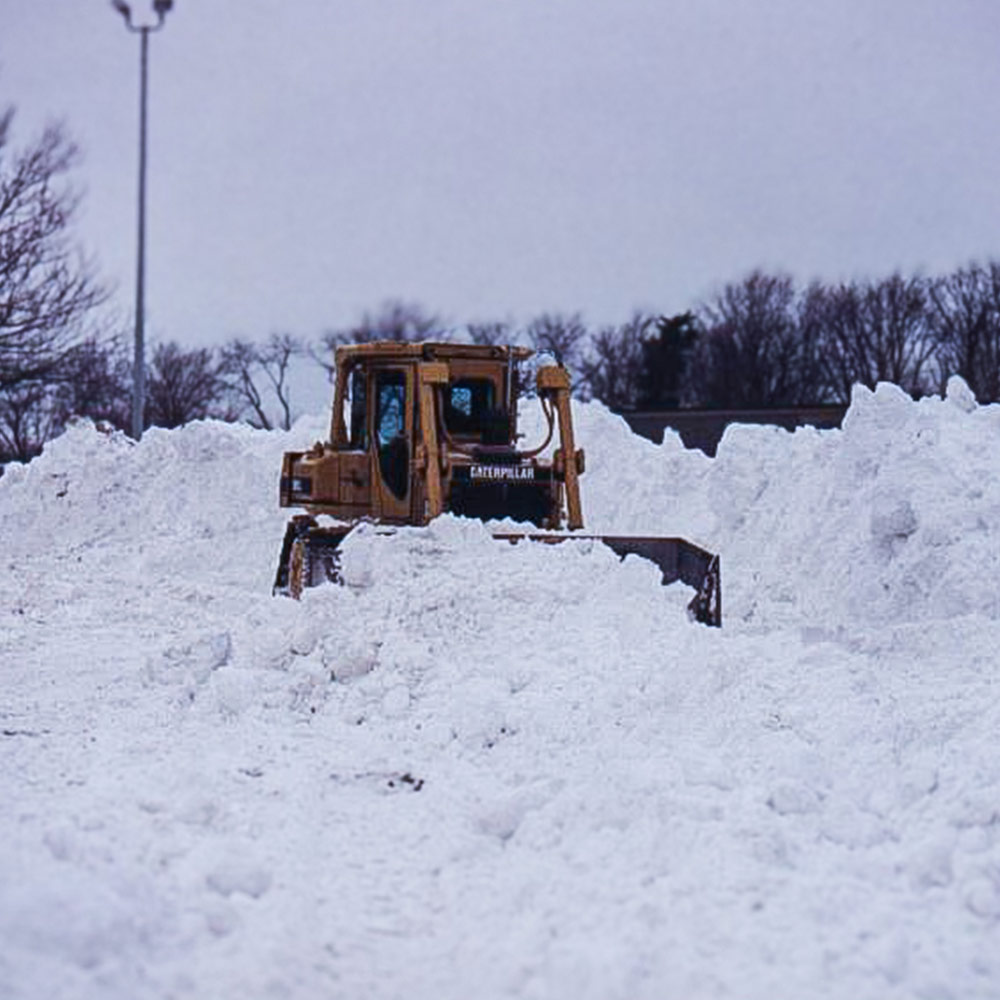
Bucks County weather does the rest. The National Weather Service office in Mount Holly covers this area, and a normal season mixes a few plowable storms with repeated freezing rain and refreeze nights. Piles build, shrink, then refreeze into something a plow cannot move. By mid February that strip is gone. Loading and hauling the snow off site becomes the only real fix, and it is the largest cost escalator on any property. So we price it into the scope up front. Snow storage is the quiet half of warehouse snow removal in Bucks County, and it belongs on your site map.
Refreeze deserves its own line in the plan. A 38 degree afternoon followed by a 25 degree night undoes a clean morning, and on a yard pitched toward the dock pits meltwater knows where to go.
Shift Change Decides the Sequence
Every site we service gets a written priority order before the season. Fire lanes and emergency access come first, then entrances onto the public road, then drive aisles, then ADA spaces and the routes to the door, then loading and service areas, then general parking, then walks timed so plow piles do not undo finished work.
For a distribution building that order gets tuned around people and freight. A first shift starting at 6 a.m. needs the employee lot and the walk open before trucks move. A building running three shifts never gets a quiet window, so warehouse snow removal in Bucks County has to work in pieces on those sites. Tell us the shift times and the inbound appointment windows during the site walk.
Entrances deserve a second look too. Industrial drives often meet high volume state roads, and some frontage falls under PennDOT rather than the township. Conditions there show up on 511PA, which helps when you are weighing whether to hold a shift.
What Actually Sets the Price for Warehouse Snow Removal in Bucks County
There is no single county rate, and any number quoted over the phone was not based on your property. These are the measurable things that move it.
- Cleared square footage, meaning the paved area we push, not the parcel size.
- Site layout and stacking room, because a yard with nowhere to pile snow needs hauling.
- Trigger depth and service level, since a zero tolerance site gets several visits per storm.
- Walkway linear footage, because entries and ADA ramps are priced apart from pavement.
- Billing structure, per event, a fixed seasonal number, or time and materials.
Per event billing costs less in a mild winter and more in a heavy one. A seasonal contract holds the budget still either way, which is why facilities directors running several buildings usually choose it. Full detail sits on our commercial snow management page.
A Straight Answer About Storm Nights
Emergency snow removal is not a separate round the clock service at The Lingo Group, and we do not run an emergency hotline. There is no guaranteed emergency response window either. Contracted properties get serviced on the schedule their trigger depth and priority tier set, and the office line answers Monday through Friday, 8:00 AM to 4:00 PM.
Documentation is worth settling early as well. Industry groups such as SIMA have pushed per visit service records for years. The reason shows up when a claim arrives a year after the fall. So ask what gets logged, and ask to see a sample before you sign.
The Lingo Takeaway
Warehouse snow removal in Bucks County gets decided at the dock apron and the fence line, not in the middle of the lot. Set two trigger depths. Mark your pile zones against the grade and the drains. Write the priority sequence around your shift times. Those three things carry a building through February better than any promise about response speed. Routes also fill with properties that commit early.
Common Questions
Do you handle warehouse snow removal in Bucks County?
Yes. Industrial parks are one of the property types we cover for commercial snow and ice from our Chalfont base. That area runs from Doylestown and New Britain through Warrington, Warminster, Horsham, Montgomeryville, Hatfield, Lansdale and Buckingham.
What trigger depth should an industrial lot use?
Most land in the standard business band, 1.5 to 2.0 inches. Walkways and ADA routes usually sit at 0.5 inches on the same site, because foot traffic carries a different kind of exposure.
Can you clear a truck court while trailers are parked in it?
Yes, and the plan should assume it. We ask which rows your dispatcher keeps open, then plan stacking around a partly full court instead of an empty one.
What happens when the yard runs out of stacking room?
We load and haul the excess snow off site. It is the biggest cost escalator on any property, so we price it into the scope before the season rather than after the third storm. More on snow hauling in Bucks County.
By Town
Commercial snow contracts are routed separately from grounds maintenance. Start with your township.
- Commercial snow removal in Doylestown, PA
- Commercial snow removal in Warrington, PA
- Commercial snow removal in Chalfont, PA
- Commercial snow removal in Newtown, PA
- Commercial snow removal in Buckingham, PA
If you are lining up warehouse snow removal in Bucks County for this winter, call us at (215) 343-7700, Monday through Friday, 8:00 AM to 4:00 PM, or use our contact page. We will walk the yard with you, mark the pile zones and the priorities, and put a real scope on paper before the first flake.