
HOA and Condo Association Snow Removal in Bucks County, PA
September 12th, 2026
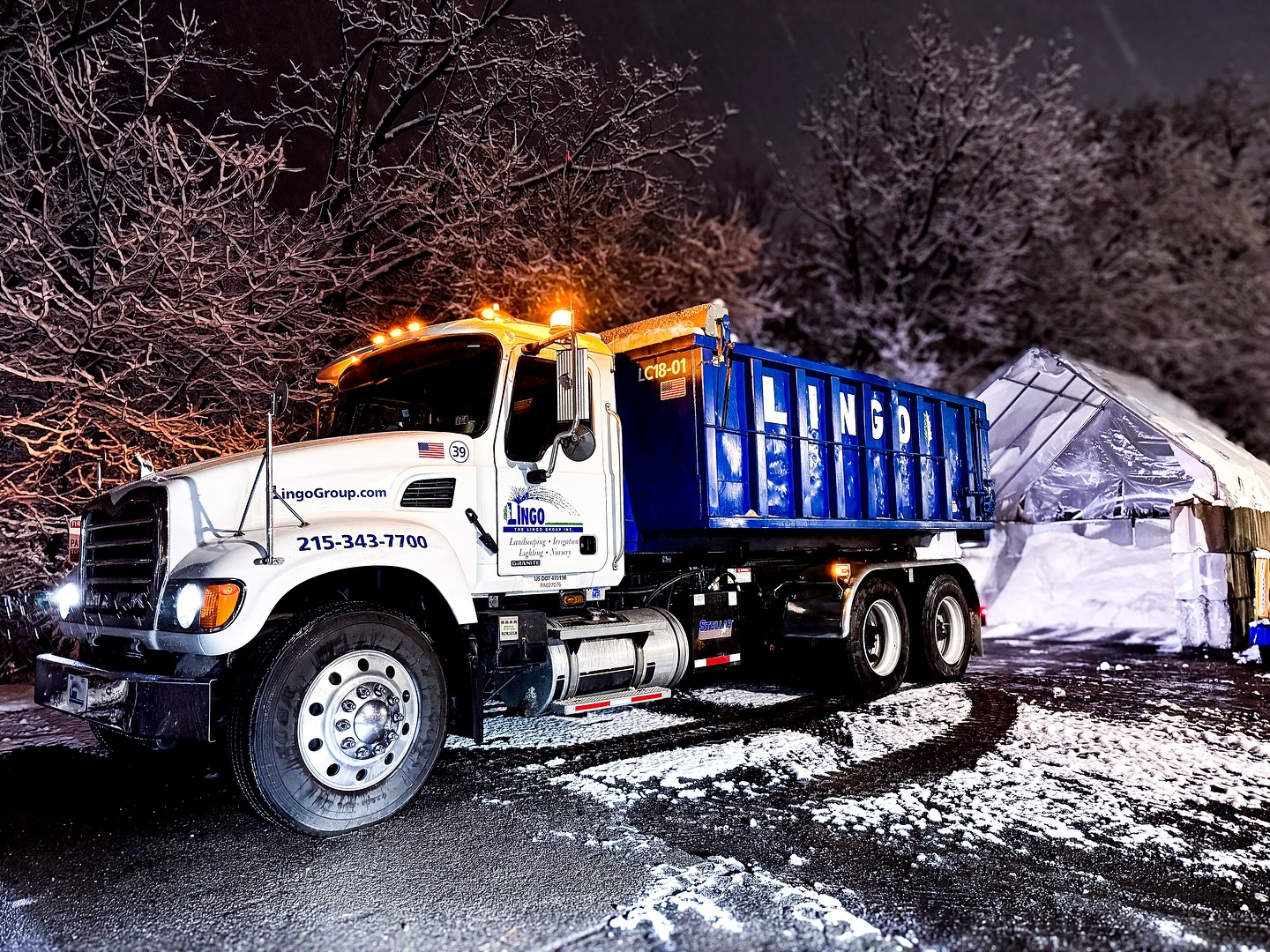
Association snow removal is a different job from commercial snow removal, and the difference isn’t the equipment. It’s that you’re serving a board with a fixed budget, residents who all believe their building should be first, and a set of governing documents that decide who’s responsible for which square foot of pavement.
We’ve handled snow and ice for communities across Bucks County for decades. Here’s what boards and property managers should sort out before winter.
The line between common element and your front step
Most disputes we see in January trace back to a question nobody answered in September. Your governing documents split the community into categories, and each one carries a different snow obligation.
| Area | Typically | Usual snow responsibility |
|---|---|---|
| Private roads and drive aisles | Common element | Association |
| Guest and overflow parking | Common element | Association |
| Main walkways and mail areas | Common element | Association |
| Assigned driveways and parking pads | Limited common element | Varies, check the documents |
| Walk from driveway to front door | Limited common or unit owner | The most commonly disputed item |
| Patios, decks, rear steps | Usually unit owner | Unit owner |
That fifth row causes more board complaints than everything else combined. Get a decision on it in writing, put it in the contract scope, and tell residents before the first storm rather than after it.
The township is not coming down your street
A lot of communities in Doylestown Township, Warrington, Buckingham, and Northampton are built on private streets. The township does not plow them. Residents who moved from a municipality with public streets often assume otherwise, and they find out during the first real storm.
Private roads also mean the association carries the full burden of access. Emergency vehicles, school buses, deliveries, and residents leaving for work all depend on your contractor, not on PennDOT or the township. That raises the stakes on response time and it usually argues for a lower trigger depth than a commercial lot would use.
Worth confirming before the season: whether your streets are private or public, where the maintenance boundary sits, and whether any portion fronts a state road with its own rules. We map that per community.
You can’t send residents a surprise invoice in February
Boards have a problem commercial owners don’t. You set assessments in advance and you can’t send residents a surprise invoice in February because it was a heavy winter. That pushes most associations toward a fixed seasonal contract.
| Structure | How it works | Fit for associations |
|---|---|---|
| Seasonal fixed | One price for the season regardless of snowfall | Strong. Predictable line item, easy to assess |
| Per event | Billed per push and per application | Workable with a healthy reserve, risky without |
| Seasonal with material cap | Fixed service price, deicing billed to an agreed ceiling | Good middle ground, protects both sides |
| Multi-year seasonal | Fixed price locked across two or three winters | Best budget stability, smooths out a bad winter |
A seasonal contract is insurance in both directions, and over three or four winters it evens out. What your board gets in the meantime is a number it can actually put in a budget, hold to, and defend to residents. For an association, that certainty is worth considerably more than trying to squeeze the last dollar out of a mild season and getting hammered in a heavy one.
One thing to watch: a seasonal price that looks noticeably low for the size of your community usually means the scope is thin. Check the trigger depth and the sidewalk scope before comparing numbers. Two proposals with a $12,000 gap often turn out to be quoting two different jobs.
Hills and ridges, and the pile that voids it
Pennsylvania’s hills and ridges doctrine gives property owners meaningful protection. You aren’t expected to keep every surface bare during an active storm, and generally slippery conditions during snowfall usually don’t create liability on their own.
The protection has limits that matter for communities. It doesn’t apply to an isolated ice patch on otherwise clear pavement. And it doesn’t apply when the ice was created artificially rather than by nature. For an association, the common version of that is a plow pile stacked uphill of a walkway or at the top of a sloped drive. It melts through the afternoon, runs across the walk, and freezes after dark. That ice came from the plow, not the sky.
Communities with sloped sites, and there are plenty in upper Bucks, need pile placement planned around grade and drainage before the first event. We map pile zones on a site plan in the fall. It’s a five-minute conversation in October and a serious problem in January.
Documentation matters here too. If a resident or guest files a claim months later, your insurer will want records showing when crews were on site and what was applied. We log every visit per community for exactly that reason, and the board gets the record without having to ask for it.
Most complaints aren’t about the snow
Half of board complaints about snow service aren’t really about the snow. They’re about nobody telling residents what to expect.
Before the season, send residents three things. Your trigger depth and roughly when service starts. The order areas get cleared, so the last building knows it isn’t forgotten. And a clear statement of what residents handle themselves, especially that front walk. We’ll supply the operational detail for that notice so your board isn’t writing it from scratch.
The other useful one is a parking request. Communities that ask residents to consolidate vehicles during an event get cleared faster and more completely than communities that don’t, because crews aren’t plowing around scattered cars and coming back twice.
Short runs from the Chalfont yard
We handle snow and ice for condominium associations, townhome communities, active adult and 55-plus communities, and single-family HOAs across Doylestown, Chalfont, Warrington, Newtown, and Buckingham, plus New Britain, Warminster, Perkasie, Sellersville, and surrounding townships. Our Chalfont yard keeps response times tight across central and upper Bucks.
Communities that use us for grounds maintenance through the year get an advantage in winter. The same crews that mow, mulch, and run the irrigation know where every head, curb, and bed sits when it’s dark and buried.
The Lingo Takeaway
The associations that get through winter without a fight are the ones that settled three questions in the fall: who clears what, where the snow goes, and what residents were told. None of that is about equipment. It’s about having the conversation in October instead of arguing about it in a group email in January.
Common questions
When should our board put snow service out to bid?
Late summer into early fall, ahead of budget approval. Boards that wait until November are choosing from whoever still has route capacity, which is not the same as choosing the best fit.
Does the association or the unit owner clear the front walk?
Your governing documents decide, and communities differ. Whatever the answer is, put it in the contract scope and tell residents before the season. The problem is almost never the answer. It’s that nobody knew what the answer was.
Our streets are private. Will the township help in a big storm?
No. Private roads are the association’s responsibility regardless of storm size, which is why response time and trigger depth matter more for communities than for a typical commercial lot.
What trigger depth should a community use?
Most associations land between one and two inches. Communities with a lot of older residents often go lower, or to zero tolerance on walkways, because a fall carries more consequence. We’ll recommend based on your layout and demographics.
Can you handle several communities for one management company?
Yes. If you manage multiple associations across Bucks County, we’d rather run them under one agreement with one point of contact than have you chase five contractors during a storm.
What if we sign seasonal and it barely snows?
You paid for availability and you got a mild winter, which is a good outcome. In a heavy winter the math runs the other way and your budget holds. That trade is the point of a seasonal agreement, and it’s why multi-year terms tend to serve boards well.
Budget season is the window
We’re pricing association snow contracts for this winter now. Call (215) 343-7700 or use our contact form and we’ll walk your community, map pile zones and priorities, and put a seasonal number in front of your board in time for budget season.
More on our snow and ice management services and how commercial snow pricing works.
By town
We price and route commercial snow work town by town. See commercial snow removal in Doylestown, Warrington, Chalfont, Newtown and Buckingham.