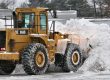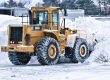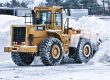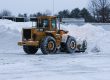

Commercial snow removal equipment Bucks County managers end up hiring gets chosen by the lot, not by the catalog. Most people asking what commercial snow removal equipment Bucks County contractors run are really asking something narrower. Will the machines that pull in at 4:00 AM actually fit this property? A pickup with a straight blade clears a six space pad site fine. That same truck is still grinding through a twelve acre industrial lot at lunchtime.
So the fleet question is really a site question. Lot shape, stacking room, walkway footage and tenant clocks decide which machines belong where. Here is how those pieces line up, and what each class of machine is good at.
What a Site Walk Is Really Measuring
Before any machine gets assigned, somebody measures the place. We walk the site, measure it and quote against conditions rather than guessing. Paved area is not parcel size, and the gap runs large. A 90,000 square foot parcel might carry 40,000 square feet of pavement and 600 linear feet of sidewalk.
Four numbers come out of that walk, and they set the equipment list:
- Cleared square footage, meaning the pavement crews actually push.
- Site layout and stacking room, which decides whether pushing alone can finish.
- Walkway linear footage, since ramps and entryways price apart from the lot.
- Trigger depth and service level, because a 1.0 inch site dispatches far more often than a 2.0 inch one.
Horsepower never appears on that list. Instead the site picks the machines, and the machines then set how long a storm takes.
Commercial Snow Removal Equipment Bucks County Lots Keep Busy
Three classes of machine do most of the pushing on commercial ground. Each one earns its place differently, and the Snow and Ice Management Association builds its industry standards around that same split.
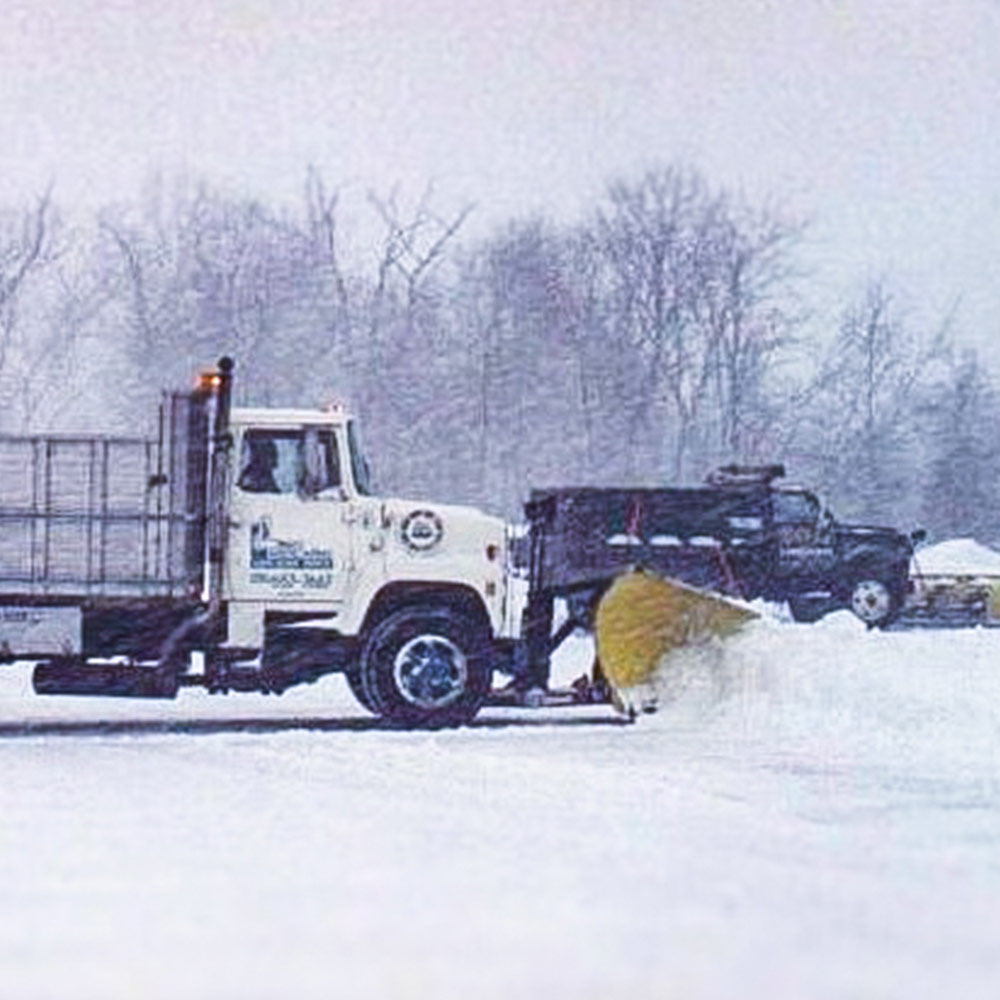
- Plow trucks open a property fast. Straight blades and V blades cut drive aisles, access roads and fire lanes first, so tenants can get in. On a small lot a truck may be the whole job.
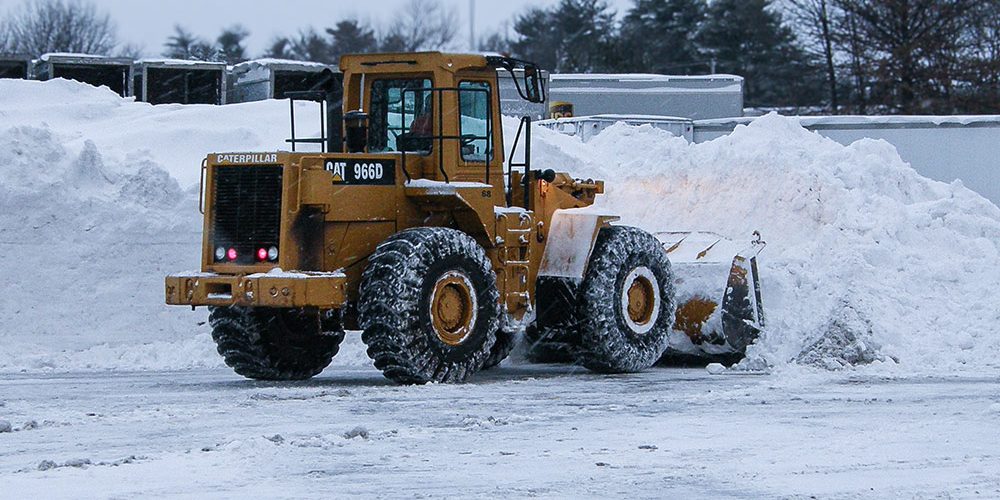
- Loaders and backhoes with box pushers move volume. A box pusher carries snow forward instead of casting it sideways, which matters on wide pavement. They also stack piles high enough to buy another storm of room.
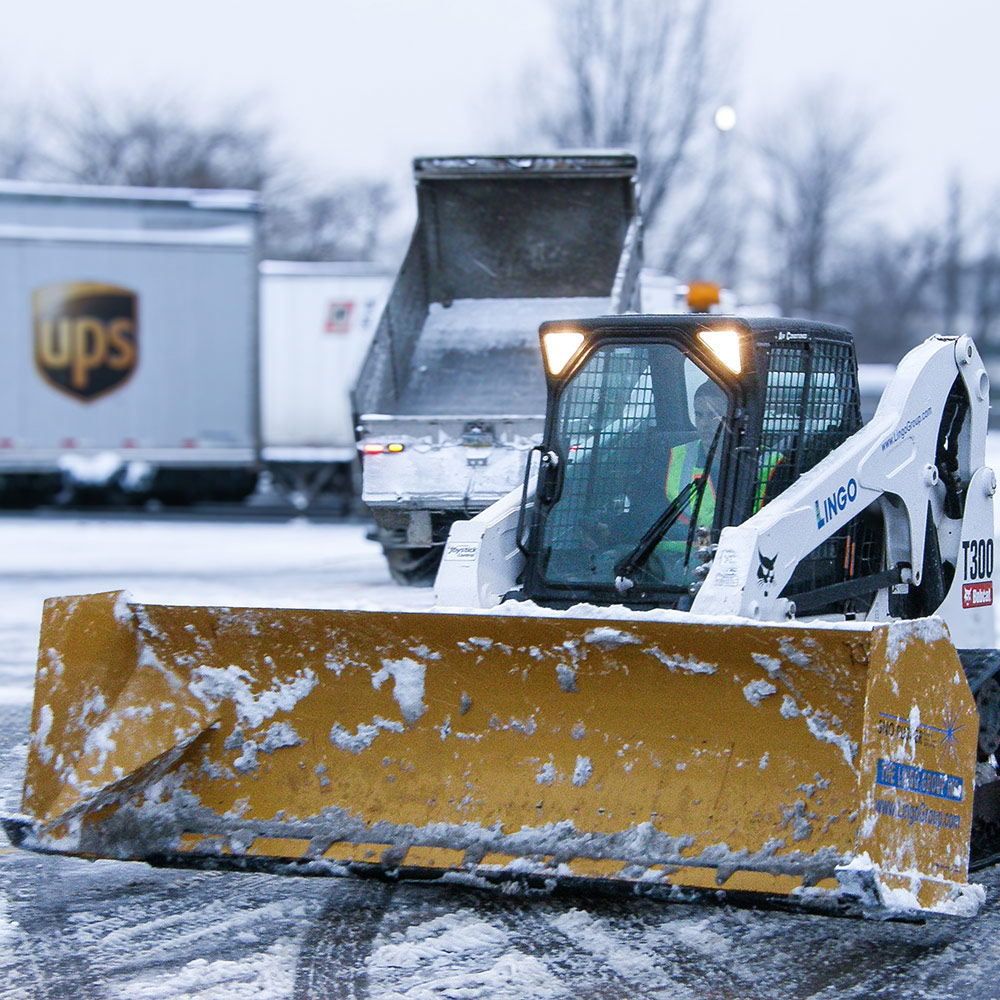
- Skid steers and compact track loaders take the awkward parts. Drive through lanes, dock aprons, cart corrals and landscape islands need a machine that turns in its own length.
Most sites need two of the three. A strip center off Street Road in Warminster runs trucks on the aisles and a skid steer around the storefronts. Meanwhile a flex building on the Route 611 corridor through Warrington may need a loader and little else.
Sidewalks Do Not Share the Lot Hardware
Walkways get their own machines, and that surprises people reading a first quote. A plow truck cannot clear a five foot sidewalk or an ADA ramp. So the commercial snow removal equipment Bucks County walkway crews carry looks nothing like the lot fleet. Walk behind blowers, compact walk behind units, hand crews and small spreaders do that work.
The trigger is different too. We build commercial contracts around set tiers, and sidewalk specific service sits at 0.5 to 1.0 inch. The lot itself usually runs at 1.5 inches. Walkways carry more liability per square foot, so they get cleared earlier and salted more often. Our walkway service covers sidewalks and walkways as a separate scope, priced by linear footage.
Worth doing on your own property: count the doors, the ramps and the paths between buildings. Then check whether your current contract names any of them.
The Spreader Half of the Job
Pushing snow only solves half of a storm. The other half is ice, and ice runs on spreaders rather than blades. Tailgate and hopper units spread granular salt across lots, while liquid tanks lay brine down before a storm arrives. PennDOT defines pretreatment, anti icing and de icing in its winter tools and terms glossary, and that vocabulary belongs in your contract.
Timing drives the material choice. Rock salt slows down badly as pavement temperature falls toward twenty degrees, a limit Penn State researchers cover in their work on road salt. Below that, crews switch materials or lose the application. Our ice control includes de icing and anti icing treatments, because a lot that glazes over at 9:00 PM was never really clear.
Bucks County makes this harder than the forecast suggests. Clay ground drains slowly, so meltwater pools and refreezes along the same lane each night. Our notes on de icing in Bucks County cover salt, brine and timing in more detail.
When the Piles Stop Melting
Every lot has a ceiling. After two or three storms inside ten days, the banks along the perimeter stop shrinking and start stealing spaces. At that point pushing is finished as a strategy, and loading becomes the work.
That shift calls for different iron, which is why commercial snow removal equipment Bucks County contracts should mention loaders and dump trucks. Loaders lift snow, and the trucks carry it off site. We load and haul excess snow when a lot runs out of room, and that work prices separately. So a tight property should carry a hauling line from the start. Our breakdown of snow hauling in Bucks County covers how that call gets made.
Pile placement decides how long you can delay it. Pick the corner during the site walk, downhill of the doors and away from the drainage inlet.
Why a Chalfont Yard Shows Up in Your Clock
Machines sitting forty minutes away are slower than smaller machines sitting five minutes away. We operate out of 1170 Timber Lane in Chalfont. That puts commercial snow removal equipment Bucks County routes rely on within roughly a five mile radius of most corridors we maintain. Routes then get built around properties that commit before the season starts.
We are also straightforward about the limits. The Lingo Group does not run an emergency snow hotline and does not promise an emergency response window. Contracted properties get service on the schedule their trigger depth and priority tier establish. The office answers at (215) 343-7700 during business hours, Monday through Friday. Statewide crews work the same way, as PennDOT explains in its winter operations overview.
Questions Worth Asking Before November Ends
Fleet answers get vague fast, so ask about your property instead. These five questions sort serious bids from guesses, and our notes on snow removal bids you can compare cover the rest.
- Which machines work this lot, and which parts get a skid steer?
- Who clears the walkways and ramps, and at what trigger depth?
- Where do the piles go, and when does hauling start?
- What material gets applied below twenty degrees?
- Does anyone inspect the property between storms?
That last one gets skipped most often. We run property inspections through the season to flag hazards, and that record is what you hand an owner or an insurer later.
The Lingo Takeaway
Nobody should buy a fleet list. Buy a match between your pavement and the machines that show up on it. Measure the cleared square footage, count the walkway footage, pick the pile corner, then set a split trigger so walks run tighter than the lot. Also ask how far the equipment sits from your address, because commercial snow removal equipment Bucks County routes run on geography. Properties that settle all that in the fall spend February reconciling invoices. The ones that wait spend it fielding complaints.
Common questions
Does a bigger machine always clear a lot faster?
Not on a tight site. A loader needs room to run straight, so a cramped pad site may clear faster with two skid steers. Lot geometry beats machine size more often than people expect.
Why do sidewalks cost extra when the lot already gets plowed?
Because different machines and crews do that work. Walkway service runs on walk behind equipment and hand labor, priced by linear footage. Walks also carry a lower trigger, so they get serviced more times per season.
What commercial snow removal equipment Bucks County sites need for ice, not snow?
Spreaders, mostly. Granular salt goes out on hopper and tailgate units, while brine goes down ahead of a storm through liquid tanks. Our ice control covers de icing and anti icing treatments on contracted properties.
Can The Lingo Group reach my property during an overnight storm?
No, and we would rather say so before you sign. There is no emergency hotline here and no guaranteed emergency response window. Dispatch follows the trigger depths and priority tiers set during the site walk. The office takes calls at (215) 343-7700 Monday through Friday.
By town
Winter routes get organized around the towns where we concentrate commercial work. So the commercial snow removal equipment Bucks County properties see depends partly on which run they sit on. These pages explain how each route comes together.
- Doylestown, PA commercial snow removal
- Chalfont, PA commercial snow removal
- Warrington, PA commercial snow removal
- Newtown, PA commercial snow removal
- Buckingham, PA commercial snow removal
We also work in New Britain, Warminster, Perkasie, Sellersville, Horsham and the surrounding townships. The full scope of our commercial snow and ice management service covers lots, driveways, access roads, walkways, de icing, loading and hauling.
Walk your lot with us before the first storm. Call (215) 343-7700 during business hours or use the contact page, and we will measure the pavement and name the machines your property needs.