

A retail lot is the hardest commercial property in Bucks County to clear. Shopping center snow removal Bucks County work gets planned in October, not during the storm. The pavement belongs to one owner. The opening times belong to a dozen tenants. Nobody wants to referee that at 4 am with four inches down.
Centers along Route 611, Route 202 and Street Road share problems an open industrial lot never has. Parking counts run tight. Entrances feed straight onto busy state roads. Then add cart corrals, storefront walks and a tenant mix with five different opening times. We have handled commercial snow removal for retail centers, medical offices, industrial parks and HOAs across Bucks County for decades. Retail sites reward planning the most.
Ten leases, ten different opening bells
Shopping center snow removal Bucks County planning starts with the leases. On an office park you clear the lot and you are done. A center works differently. The grocery anchor takes deliveries before dawn. The gym opens at 5, the salon at 10, the restaurant at 11. Clear in whatever order is convenient and somebody opens to a plowed-in storefront.
So we ask for the tenant schedule during the site walk. Then we build the sequence around it. The anchor entrance and its walk come first when the early traffic lands there. After that come the aisles feeding the rest of the storefronts, in door order. Clearing in a smart order costs nothing extra. It only happens if somebody wrote the order down in the fall.
Shopping center snow removal Bucks County crews run off a priority sheet
Every site we take gets a written priority sequence before the season. Fire lanes and emergency access go first. Then entrances onto the public road, then drive aisles. ADA spaces come next, along with the routes connecting them to the door. After those, loading and service areas, then general parking. Walks and crosswalks come last, timed so plow piles do not undo finished work.
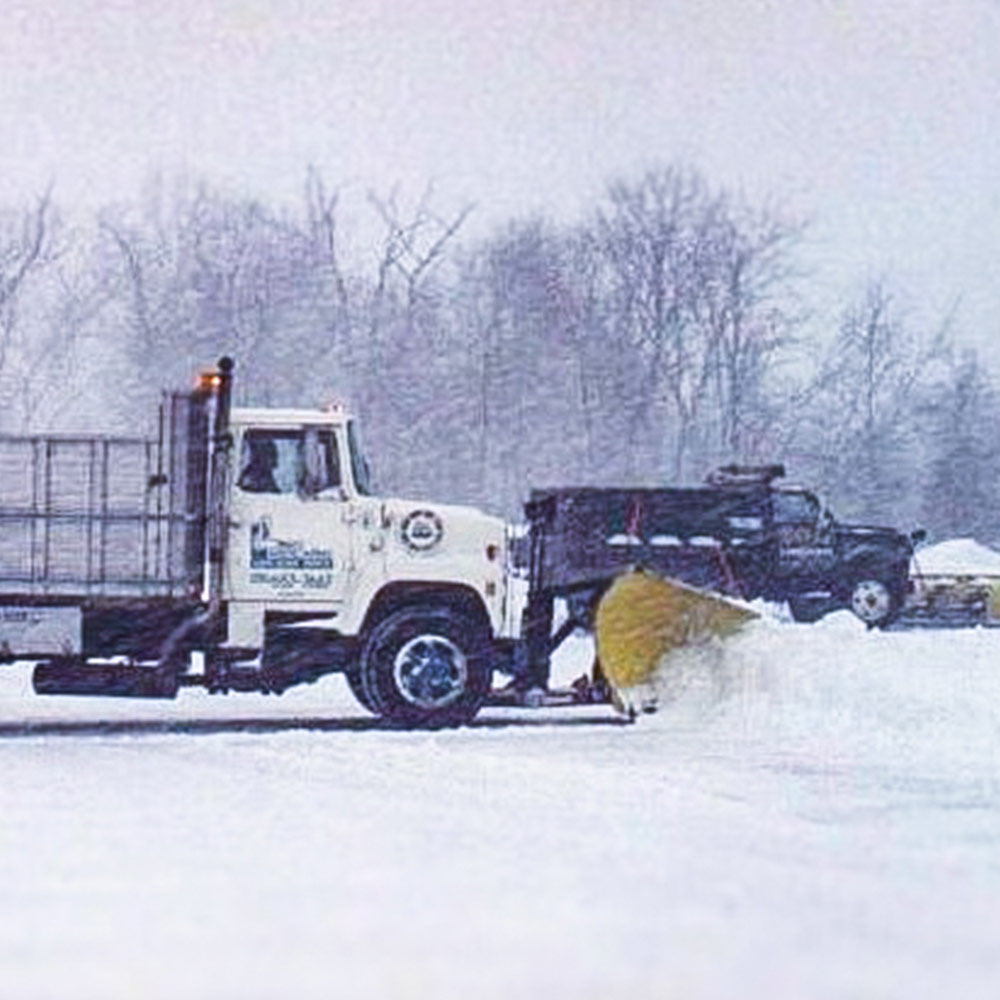
That last item matters more on retail than anywhere else. Clear a storefront walk at 3 am. Push the adjacent aisle at 5. You have just buried the walk your crew finished two hours ago. Sequencing the two together is the difference between one trip and three.
The pile has to go somewhere, and that somewhere decides your risk
Pennsylvania’s hills and ridges doctrine gives owners real protection during an active storm. You are not expected to hold bare pavement while it snows. But the doctrine has a limit most owners miss. It does not cover ice that formed artificially rather than naturally.
Here is how that bites a center. Snow stacked uphill of a storefront walk melts all afternoon. The meltwater runs across the pavement where customers park. Then it locks up after dark once the temperature drops. That ice came off the plow, not out of the sky.
So we plan pile zones against grade and drainage before the first event. We mark them on a site plan you keep. We also log time on site and material applied for every visit. A claim can land in March over a January fall. That record is the strongest thing you can hand your insurer.
Pile placement is also pure math. Say a center has 180 spaces and loses 40 to snow storage by mid-February. That is a revenue problem, not a snow problem. When a lot runs out of room we load and haul the excess off site. We price that into the scope up front instead of raising it mid-winter.
One inch is the number most retail contracts land on
A trigger depth is the accumulation that has to fall before crews roll. We build commercial agreements around four tiers. Shopping centers almost always sit in the high-traffic band at 1.0 inch, next to banks and medical offices. Zero tolerance means a trace to 0.01 inch of ice, and we reserve it for hospitals, emergency rooms and 24/7 retail. Standard business sites like warehouses and private office parks run 1.5 to 2.0 inches. Walkways and ADA ramps carry their own trigger at 0.5 to 1.0 inch.
Most centers do better with a split trigger than one number for the whole site. Set the walks at 0.5 inches for liability reasons. Set the lot at 1.5 inches for efficiency. Run both at the same depth and you either overspend on the lot or underserve the sidewalk. Claims start on the sidewalk.
Timing comes down to watching the right forecast. Our crews track conditions and refreezing risk ahead of each event. The National Weather Service office in Mount Holly is the feed that covers Bucks County. For the state roads your entrances feed, 511PA shows what PennDOT is doing on 611, 202 and 309.
Carts, curbs and the things buried under the snow
Retail lots are full of obstacles that cost money when a plow finds them first. Cart corrals and bollards. Light bases and landscape islands. Curb returns and irrigation heads along the storefront. An operator who has never seen the site in daylight finds all of them in the dark.
We install irrigation, beds, lighting and hardscape on many of the properties we plow. So we know what sits under the snow. Heads get mapped and staked before the first event. Curbs and islands get marked. Pile zones get assigned off the beds, so melt runs away from the walks. Staking a center in November takes a morning. Replacing a season of sheared heads and broken curb shows up in your spring budget.
What the agreement should name before you sign it
Whoever handles shopping center snow removal Bucks County work for you, get the details in writing before November. Six items belong in every retail scope.
- The trigger depth for the lot, and a separate one for the walks
- The written priority sequence, built around tenant opening times
- Marked pile locations, with haul-off terms if the lot fills
- Who covers storefront walks versus pavement
- What de-icing material goes down, and how it gets billed
- What documentation arrives after each event
The Snow and Ice Management Association has published best practices on documentation for years. Contractors who follow them are the ones whose records hold up in a claim.
One more point, because plenty of contractors dodge it. We do not run a 24/7 emergency hotline, and no emergency response window comes with our agreements. Contracted properties get serviced on the dispatch schedule their trigger depth and priority tier establish. If your center needs round-the-clock coverage, say so during the site walk. Then we will tell you honestly whether we can meet that standard.
Managing several centers changes the math. One agreement, one point of contact and one billing cycle beats four conversations during a storm. We take shopping center snow removal Bucks County portfolios under a single scope.
The Lingo Takeaway
Equipment is rarely the reason shopping center snow removal Bucks County goes sideways. It goes sideways because nobody settled the order, the piles and the triggers while it was still 60 degrees out. Our yard on Timber Lane in Chalfont sits roughly five miles from the county’s main commercial corridors. That proximity beats any promise on a proposal. Walk the site with us in October. Write down the sequence and mark the piles. The storm becomes a routine night instead of an argument.
Common questions
What trigger depth should a shopping center use?
Most shopping center snow removal Bucks County agreements land at 1.0 inch for the lot. That is our high-traffic tier. Walks and ADA ramps usually go tighter, at 0.5 to 1.0 inch, because slip claims start there.
Can you work around tenants who open at different times?
Yes, and every shopping center snow removal Bucks County scope we write starts with that schedule. We build the clearing sequence around opening times rather than whatever order is convenient.
Do you handle the storefront sidewalks too?
We do, and you want both from one provider. Split the lot and the walks between two contractors and you get a plow pile sitting on a freshly cleared walk.
What happens when the lot runs out of stacking room?
We relocate piles first. Then we load and haul snow off site when relocation is not enough. Bucks County can hand you three storms in ten days, so haul-off belongs in the scope before the season starts.
Do you plow residential driveways?
No, we do not. Single-family driveways sit outside what we are built for. Every truck and operator we have points at commercial properties like yours.
By town
We run shopping center snow removal Bucks County routes out of Chalfont, covering central and lower parts of the county. Retail corridors in each town have their own quirks, so each one has its own page.
- Commercial snow removal in Warrington, PA
- Commercial snow removal in Doylestown, PA
- Commercial snow removal in Newtown, PA
- Commercial snow removal in Chalfont, PA
- Commercial snow removal in Buckingham, PA
More detail sits on our snow management services page. Two related reads cover parking lot snow removal in Bucks County and snow hauling when a lot fills up.
Lining up your center for the season
We build routes around properties that commit before the season. Once a route is full, it is full. Call us at (215) 343-7700 Monday through Friday, 8:00 AM to 4:00 PM. You can also reach us through the contact page. We will walk your center, mark the piles and priorities, and put a real scope in front of you.